

Updated July 2026
In brief:
- Moisture is essential for maintaining scalp barrier health and preventing chronic dandruff symptoms.
- Dehydration and barrier damage lead to microbial imbalance, causing inflammation and flaking.
- Targeted, microbiome-friendly moisture restoration offers long-term relief over harsh anti-dandruff treatments.
Scalp flaking is widely treated as a surface problem. Brush it off, wash it away, move on. But the science tells a different story. Research shows that dandruff scalps experience significantly increased water loss, reduced hydration, and measurable barrier damage that no anti-dandruff shampoo alone can fix. Moisture is not a cosmetic luxury for the scalp. It is a functional necessity. Without it, the barrier breaks down, inflammation builds, and chronic symptoms persist. This article draws on current research to explain why moisture sits at the centre of lasting scalp health and what that means for how you approach care.
Table of Contents
- The scalp's barrier: Why moisture is essential
- Moisture, microbiome and the roots of scalp health
- Moisture distinguishes dry dandruff from oily dandruff
- How lifestyle and treatment choices impact scalp moisture
- Why microbiome-friendly moisture is the missing piece in scalp care
- Discover Victory Serums
- Frequently asked questions
Key Takeaways
| Point | Details |
|---|---|
| Scalp moisture protects barrier | Moisture is critical for maintaining scalp barrier function and preventing chronic flaking and irritation. |
| Microbiome thrives with hydration | Balanced moisture helps the scalp's microbiome stay healthy, reducing pathogen growth and inflammation. |
| Lifestyle affects moisture balance | Frequent washing and harsh treatments increase moisture loss, so gentle routines are key for scalp health. |
| Dry vs oily dandruff explained | Identifying the type of dandruff informs the right moisture-based approach for relief. |
| Barrier-supporting treatments work | Moisture-driven therapies with humectants, occlusives, and ceramides relieve symptoms and promote long-term scalp health. |
The scalp's barrier: Why moisture is essential
The outermost layer of the scalp, the stratum corneum, acts as a physical shield. It keeps irritants out and water in. When this barrier is working properly, the scalp stays calm, hydrated, and resilient. When it is compromised, everything changes.
Transepidermal water loss, or TEWL, is the clinical measure of how much water escapes through the skin. In a healthy scalp, TEWL is low. The barrier retains moisture effectively. But in people with chronic dandruff, that balance shifts. Research confirms that dandruff scalps show increased TEWL, alongside decreased hydration, higher redness, dryness, flakiness, and itchiness compared to healthy scalps.
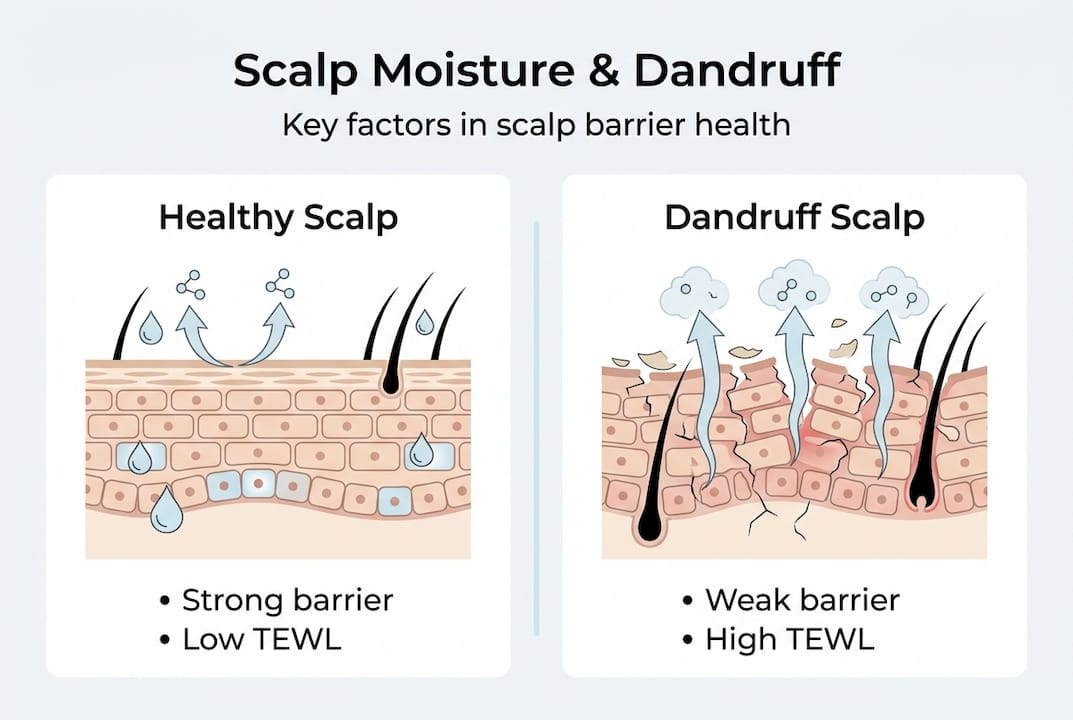
Ceramides are lipids that hold the barrier together. Think of them as the mortar between bricks in the stratum corneum. In dandruff-affected scalps, ceramide composition is altered. Specific ceramide types are reduced or replaced, weakening the barrier's ability to hold moisture and resist irritants. This is not a minor detail. It is a structural deficiency that makes the scalp more reactive and harder to settle.
The scalp's barrier function also depends on maintaining a mildly acidic pH, typically between 4.5 and 5.5. Products that disrupt this range can further compromise the barrier, accelerating moisture loss and creating conditions where irritation and flaking become self-reinforcing.
| Scalp measure | Healthy scalp | Dandruff scalp |
|---|---|---|
| TEWL | Low | Significantly elevated |
| Hydration | Normal | Reduced |
| Ceramide levels | Balanced | Altered and depleted |
| Redness and itchiness | Minimal | Elevated |
"The scalp requires moisture to maintain its stratum corneum barrier function, preventing excessive transepidermal water loss which leads to dryness, flaking, itchiness, and irritation in chronic dandruff."
Understanding what causes scalp flakes at this structural level changes the entire treatment conversation. With this scientific foundation, we can see why chronic scalp symptoms go deeper than surface dryness.
Moisture, microbiome and the roots of scalp health
Beyond the barrier, what is happening beneath the surface, especially with chronic irritation, is a microbial story.
The scalp hosts a complex community of microorganisms. In a well-hydrated, pH-balanced scalp, this community is diverse and stable. Protective species keep opportunistic ones in check. But when the scalp becomes dehydrated and the barrier weakens, that balance shifts. This is called dysbiosis, and it is a core driver of dandruff symptoms.
Research shows that dandruff scalp dysbiosis involves higher levels of Malassezia restricta and Staphylococcus aureus, alongside lower levels of Malassezia globosa. These shifts are not random. They reflect a scalp environment that can no longer defend itself effectively. Moisture supports the conditions that keep these microbial populations in balance.
A healthy scalp microbiome is not just about reducing bad bacteria. It is about maintaining the right environment for the whole community to function. Hydration plays a direct role in that. When moisture is restored, inflammation decreases, and the scalp becomes less hospitable to the microbes that drive flaking and irritation.
Key signs of scalp dysbiosis linked to moisture loss:
- Persistent flaking that does not respond to standard shampoos
- Itchiness that worsens after washing
- Redness or sensitivity that fluctuates without clear cause
- Greasy buildup alternating with tight, dry patches
Choosing microbiome-friendly scalp care matters because harsh antifungals and aggressive cleansers can strip the scalp of protective species, making dysbiosis worse over time. The goal is to support the environment, not sterilise it.
Pro tip: When selecting scalp products, look for formulations that sit below pH 5. This range supports the acidic environment that protective microbes prefer and helps maintain barrier integrity without chemical aggression.
For practical dandruff prevention strategies grounded in microbiome science, the focus should always be on restoring conditions rather than suppressing symptoms.
Moisture distinguishes dry dandruff from oily dandruff
Not all dandruff is the same. The flakes on your shoulders may look similar, but their origin and the scalp conditions driving them can be quite different. Moisture is the key variable that separates the two main types.
Dry dandruff versus oily dandruff is a clinically meaningful distinction. Research confirms that dry dandruff stems from moisture loss, producing small, white, powdery flakes and persistent itchiness. Oily dandruff, by contrast, is driven by excess sebum production and Malassezia overgrowth, resulting in larger, yellowish, greasy flakes that tend to clump.
| Feature | Dry dandruff | Oily dandruff |
|---|---|---|
| Flake appearance | Small, white, powdery | Large, yellow, greasy |
| Primary cause | Moisture loss | Excess sebum and Malassezia |
| Scalp feel | Tight, dry, sensitive | Oily, heavy, congested |
| Itchiness level | High | Moderate to high |
| Treatment focus | Restore hydration | Regulate sebum and microbiome |
Getting this distinction right matters because the wrong approach makes things worse. Applying heavy moisturisers to an oily scalp can worsen Malassezia overgrowth. Stripping a dry scalp with antifungal shampoos accelerates moisture loss and increases TEWL further.
A structured approach to identifying your dandruff type:
- Observe flake size and texture after washing
- Note whether the scalp feels tight and dry or heavy and oily within hours of washing
- Track whether symptoms worsen with heat, stress, or specific foods
- Adjust product choice and frequency based on what the scalp is telling you
Australian adults with chronic dandruff often cycle between both types depending on season, diet, and product use. Recognising this pattern is the first step toward targeted, effective care.
How lifestyle and treatment choices impact scalp moisture
Washing frequency is one of the most underestimated variables in scalp health. Research shows that frequent washing increases scalp TEWL, disrupting moisture balance and worsening barrier function. This effect is amplified in occluded conditions, where airflow to the scalp is reduced and heat and humidity build up. The result is a scalp that is simultaneously over-washed and under-hydrated.
Reducing wash frequency is not about hygiene. It is about giving the barrier time to recover between cleansing events. For most people with chronic dandruff, washing every second or third day with a gentle, low-pH shampoo is more effective than daily washing with a medicated product.
Product choice matters just as much as frequency. Ingredients that support barrier repair include:
- Humectants such as glycerin and hyaluronic acid, which draw moisture into the stratum corneum
- Occlusives that form a protective layer and slow TEWL
- Ceramide-restoring actives that directly address the lipid depletion seen in dandruff scalps
- Low-pH formulations that preserve the acidic environment the barrier and microbiome depend on
For targeted support, dry scalp remedies that focus on barrier restoration outperform those that simply suppress flaking. Similarly, oily scalp management requires a different formulation approach, one that regulates sebum without stripping moisture entirely.
Pro tip: Avoid antifungal shampoos used daily as a maintenance strategy. They are designed for short-term intervention, not long-term use. Overuse disrupts the microbiome and can increase barrier vulnerability over time. Explore clinical scalp treatment options that are structured around reducing frequency, not increasing dependency.
Why microbiome-friendly moisture is the missing piece in scalp care
Most people chasing dandruff relief focus on one thing: removing flakes. The product industry has reinforced this for decades. Stronger antifungals, more frequent washing, higher concentrations of active ingredients. The logic seems sound. But the evidence points elsewhere.
Research shows that moisture retention via humectants, occlusives, and ceramide restoration may promote microbiome-friendly long-term health by reinforcing the barrier, reducing inflammation, and preventing dysbiosis without the need for harsh antifungals. That is a fundamentally different approach to care.
The uncomfortable truth is that most anti-dandruff products are designed to suppress symptoms, not resolve them. They work while you use them. Stop, and the flakes return. This is not a coincidence. It reflects a treatment model built around ongoing use rather than genuine recovery.
Understanding anti-dandruff agents and how they interact with the scalp barrier is essential for making informed choices. The goal should be restoring the scalp's capacity to regulate itself, not replacing one dependency with another. Moisture-driven strategies, used with appropriate frequency and formulation, offer a path toward that outcome.
Discover Victory Serums
After more than 45 years of living with severe dandruff, the founding insight behind Victory Serums is straightforward: restoring scalp moisture is not optional. It is the foundation of lasting relief. The Victory Serums range is pharmacist-developed with pH awareness and microbiome compatibility at its core, built to support genuine recovery rather than ongoing symptom suppression.

The Victory Serums scalp serum is designed for targeted, short-term intervention during flare-ups, not daily suppression. Formulated to sit below pH 5, it supports barrier function and microbiome balance without disrupting the scalp's natural defences. It is the practical next step for anyone ready to move from symptom management to genuine scalp health.
Frequently asked questions
How does scalp moisture reduce dandruff symptoms?
Moisture restores the stratum corneum barrier, reduces transepidermal water loss, and lowers inflammation, directly addressing the physical drivers of flaking and itchiness in chronic dandruff.
What's the difference between dry and oily dandruff?
Dry dandruff stems from moisture loss, producing small, white, powdery flakes, while oily dandruff is driven by excess sebum and Malassezia overgrowth, resulting in larger, greasy, yellowish flakes.
How often should you wash your hair to maintain scalp moisture?
Washing less frequently, ideally every second or third day, reduces scalp TEWL and gives the barrier time to recover. Pairing this with a gentle, low-pH shampoo supports long-term moisture retention.
Can moisturising treatments improve microbiome balance?
Restoring scalp moisture may create a more stable environment for the microbiome, reducing harmful microbe overgrowth and supporting the protective species that keep chronic symptoms in check.
Recommended
- Why Does Dandruff Occur? Science-Backed Scalp Insights 2026 – Victory Serums
- Understanding anti-dandruff agents: sustainable relief – Victory Serums
- Dry vs oily scalp: 50% of people face dandruff care issues – Victory Serums
- Fast Acting Dandruff Relief for Oily Scalp in 2026 – Victory Serums
- Natural moisturizers: ultimate guide to youthful skin over 40
- Hydration Boosting: Complete Guide for K-Beauty Fans | B Woman

Get the free 1-Week Guide to Scalp Health and uncover the real cause of your flakes.
Download the free guide
Matt Heron is the founder of Victory Serums, an Australian microbiome focused scalp care brand specialising in severe dandruff, yeast imbalance and chronic scalp instability. With more than four decades of personal experience managing persistent dandruff and extensive study of scalp biology, skin pH and barrier function, he developed targeted scalp serums that work within minutes or as leave in treatments. His Reset, Rebalance and Restore approach challenges daily anti-dandruff shampoo dependence and is helping redefine the way chronic dandruff is treated.