

Updated July 2026
In Brief:
- Chronic scalp itch usually comes from yeast overgrowth disrupting the scalp microbiome.
- Effective treatment combines antifungal shampoo with microbiome-supportive care over several weeks.
- Give any routine three to six weeks. Changing products every fortnight prevents an honest assessment.
Chronic scalp itch is more than a minor inconvenience. It disrupts sleep, chips away at confidence, and for many Australians it becomes a daily battle that supermarket shampoos simply do not resolve. The frustrating reality is that most treatments target visible symptoms without addressing what is actually driving the itch. This guide explains the biological causes, outlines what you need, walks through a routine, and covers how to maintain results using microbiome-friendly methods.
Understanding the roots of an itchy scalp
Itching is rarely random. It is the result of specific biological processes, and knowing which one applies changes everything about how you treat it.
The most common driver is Malassezia. This yeast lives naturally on the scalp but causes problems when it overgrows. It feeds on sebum, produces irritant fatty acids, triggers an immune response and accelerates skin cell turnover. The result is flaking and itch in up to 80% of dandruff cases. When the microbiome falls out of balance, the cycle worsens and the barrier begins to break down, compounding the irritation.
Other causes include contact dermatitis from harsh ingredients, seborrhoeic dermatitis, dry scalp from over-washing or low humidity, and psoriasis. Each has overlapping symptoms but different treatment needs. Telling temporary irritation apart from chronic inflammation is critical before committing to any routine.
Quick fixes fail because they suppress symptoms without correcting the underlying imbalance. When the treatment stops, the triggers remain.
| Cause | Primary symptoms |
|---|---|
| Malassezia overgrowth | Flakes, itch, oiliness |
| Barrier dysfunction | Burning, tightness, sensitivity |
| Seborrhoeic dermatitis | Red patches, greasy scales, persistent itch |
| Contact dermatitis | Localised itch, redness after product use |
| Dry scalp | Fine flakes, tight feeling, low oiliness |
What you need: essentials and preparation
Going in without the right products often means slow progress, or accidentally making symptoms worse.
Core essentials:
- A pH-balanced gentle shampoo (pH 4.5 to 5.5) to support the acid mantle
- An antifungal shampoo containing ketoconazole, zinc pyrithione, selenium sulphide or coal tar
- A soothing scalp serum with ingredients like aloe vera or glycerin
- Clean towels and a wide-tooth comb for gentle detangling
Standard first-line treatments in Australia include antifungal shampoos used two to three times weekly, massaged into the scalp and left for several minutes before rinsing. Several TGA-registered options are available over the counter without a prescription.
| Product type | Key ingredients | Best used for |
|---|---|---|
| Antifungal shampoo | Ketoconazole, zinc pyrithione | Active flares, yeast overgrowth |
| Microbiome-friendly cleanser | pH-balanced, gentle surfactants | Maintenance, sensitive scalps |
| Soothing serum | Aloe vera, glycerin | Barrier support between washes |
Pro Tip: Patch test any new product on the inside of your wrist for 24 hours before applying it to your scalp. Reactions are rare but worth ruling out, especially with antifungal formulas.
Things to avoid:
- Sulphate-heavy shampoos that strip natural oils
- Excessive heat from dryers or straighteners directly on the scalp
- Styling gels or sprays with alcohol-based ingredients
- Over-washing, which disrupts the microbiome and worsens dryness
Microbiome-friendly formulations have a growing evidence base supporting their role alongside conventional treatment.
Step-by-step: how to soothe an itchy scalp
Consistency here matters more than intensity.
- Wet your hair thoroughly with lukewarm water before applying anything. This distributes product evenly and reduces friction on an irritated scalp.
- Apply your antifungal or gentle shampoo two to three times a week, directly to the scalp rather than just the hair.
- Massage gently for two minutes with your fingertips, not your nails. Circular movements work the actives into the scalp.
- Leave it on for three to five minutes. This is not optional for active ingredient absorption.
- Rinse thoroughly with cool or lukewarm water. Hot water disrupts the barrier and worsens inflammation.
- Pat dry with a clean towel. Avoid rubbing.
- Apply a soothing serum to a dry scalp once the hair has dried. Applying to a dry scalp matters, because water dilutes the formulation and lifts its low pH.
- Rotate your shampoos weekly, alternating between the antifungal and the gentler formula.
Leaving shampoo on for three to five minutes is not optional. Actives like ketoconazole and zinc pyrithione need adequate contact time. Rinsing too quickly significantly reduces their effectiveness.
Microbiome-friendly approaches, combining pH-balanced cleansing, antifungal rotation and soothing serums, show measurable improvement over three to six weeks.
Pro Tip: Relief does not appear overnight. Give any structured routine at least three to six weeks before deciding whether adjustments are needed. Changing products every two weeks prevents accurate evaluation.
Troubleshooting and maintaining results
Slow progress is the most common issue, and it does not mean the approach is wrong. It usually means a trigger has not been identified, or the rotation needs adjusting.
Adjustments to make if progress stalls:
- Alter the shampoo rotation frequency
- Add a microbiome-supporting serum to encourage microbial diversity
- Review recent product changes or dietary shifts that may have introduced new triggers
- Check your water temperature. Hot water is a silent disruptor.
- Consider food triggers, particularly high-sugar diets that can feed Malassezia systemically
Antifungal treatments produce good response rates for most people, and microbiome-targeted care measurably improves the ratio of beneficial bacteria. Those are useful benchmarks for tracking your own progress.
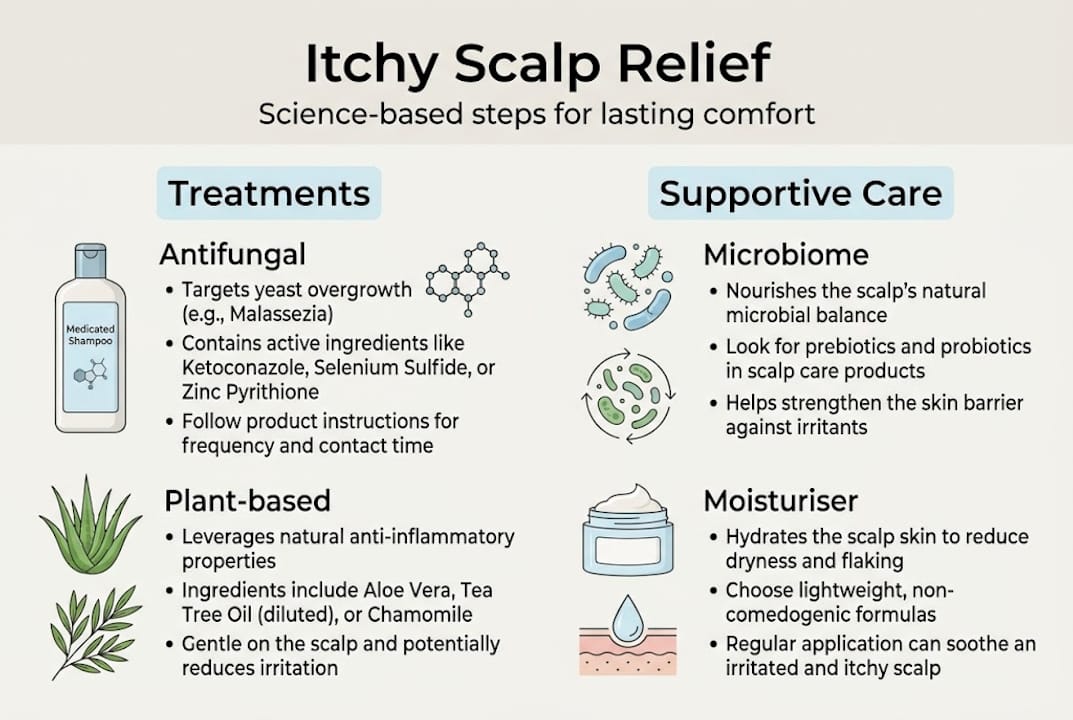
Combining conventional and microbiome-based methods is supported by growing research.
| Timeframe | Action |
|---|---|
| Weekly | Rotate shampoos, apply serum, check scalp condition |
| Monthly | Review product frequency, assess trigger exposure |
| Warning signs | Persistent redness, open sores or spreading rash: see a GP or dermatologist |
If symptoms persist beyond eight weeks despite consistent effort, a GP or dermatologist review is the right next step.
Why combining approaches is key
Neither conventional nor gentle approaches alone are sufficient for most chronic cases.
Relying only on antifungal shampoos is effective short term but carries risk. They are highly effective, yet they disrupt the broader microbiome over time, creating conditions for renewed dependency. The scalp comes to rely on chemical suppression rather than recovering its own regulation.
Microbiome-friendly products address that gap. They support the beneficial organisms that keep Malassezia in check, restore the acid mantle and reduce the overall inflammatory load. The limitation is that they work more slowly in severe cases.
The practical answer is integration: use antifungals strategically during flares, and support the microbiome consistently during maintenance. Lasting relief is not a single fix. It is a reduction in trigger load, a restoration of microbial balance, and a gradual decrease in the frequency and intensity of flares over time.
Ready for relief? Try evidence-backed scalp solutions
The routine in this guide works best with products formulated to support it. Victory Serums develops pharmacist-backed, pH-aware scalp care built around microbiome compatibility and structured relief.

The scalp serum applies directly to a dry scalp as a leave-in treatment for between-wash soothing and barrier support. Explore the full dandruff control range, all developed with the Reset, Rebalance, Restore framework in mind and designed to reduce dependency over time rather than extend it.
Frequently asked questions
How quickly can I expect results?
Most people see improvement within three to six weeks with a consistent routine that rotates a gentle cleanser and an antifungal. Patience and consistency matter more than product quantity.
Are microbiome-friendly products safe for sensitive skin?
Yes. pH-balanced products at 4.5 to 5.5 are specifically suited to sensitive scalps because they minimise disruption and support the skin's natural barrier.
What is the difference between dandruff and an itchy scalp?
Dandruff involves visible flakes and is linked to Malassezia in around 80% of cases. An itchy scalp can result from dryness, irritation or yeast overgrowth, and may or may not involve visible flaking.
Do I need a prescription for antifungal shampoos?
No. Several TGA-registered antifungal shampoos are available over the counter in Australia without a prescription.
Victory Serums products are designed to support scalp comfort and scalp health practices. They are not intended to diagnose, treat, cure or prevent medical conditions. If symptoms are severe, persistent, cracked, bleeding or worsening, seek guidance from a qualified healthcare professional.
Recommended
- Dry scalp remedies list for effective relief in 2026 – Victory Serums
- Why Does Dandruff Occur? Science-Backed Scalp Insights 2026 – Victory Serums
- Understanding anti-dandruff agents: sustainable relief – Victory Serums
- Fast Acting Dandruff Relief for Oily Scalp in 2026 – Victory Serums

Get the free 1-Week Guide to Scalp Health and uncover the real cause of your flakes.
Download the free guide
Matt Heron is the founder of Victory Serums, an Australian microbiome focused scalp care brand specialising in severe dandruff, yeast imbalance and chronic scalp instability. With more than four decades of personal experience managing persistent dandruff and extensive study of scalp biology, skin pH and barrier function, he developed targeted scalp serums that work within minutes or as leave in treatments. His Reset, Rebalance and Restore approach challenges daily anti-dandruff shampoo dependence and is helping redefine the way chronic dandruff is treated.