

Updated July 2026
In Brief:
- Customer-centric scalp care focuses on individual triggers and microbiome balance for lasting relief.
- Traditional methods often disrupt the scalp's ecosystem, leading to dependency and rebound flakes.
- Building a simple, personalized routine with targeted actives and reduced frequency improves long-term scalp health.
Most people dealing with chronic dandruff reach for the strongest product they can find. That instinct is understandable. But harsh antifungal shampoos used daily often create a cycle of dependency rather than lasting relief. Personalised, microbiome-balancing routines are proving more effective for chronic scalp concerns than chemical suppression alone. The scalp is a living ecosystem. What it needs is not constant intervention but structured, informed support that works with its natural biology. This guide explains what customer-centric scalp care actually means, how it differs from traditional approaches, and how to build a routine that delivers real, lasting results.
Table of Contents
- What is customer-centric scalp care?
- Traditional vs. customer-centric approaches
- Building an effective customer-centric scalp routine
- Common pitfalls and how to personalise your scalp care
- The truth about customer-centric scalp care: What most advice gets wrong
- Discover Victory Serums
- Frequently asked questions
Key Takeaways
| Point | Details |
|---|---|
| Microbiome balance matters | Gentle, individualised routines foster scalp health better than harsh chemicals. |
| Personal triggers are key | Stress, hormones, and routine can influence dandruff persistence and care needs. |
| Visible results come fast | Flake reduction may be possible within 24 hours, with ongoing improvement using customer-centric approaches. |
| Consistency beats quick-fixes | Ongoing daily care maintains better results than dramatic, harsh treatments. |
What is customer-centric scalp care?
Traditional scalp care treats the symptom. Customer-centric scalp care treats the person.
The difference sounds subtle but it changes everything about how you approach your routine. Instead of reaching for the same medicated shampoo every wash day, customer-centric care asks a different set of questions. What is triggering your flares? Is it stress, diet, hormonal shifts, or product overload? What does your scalp actually need right now versus what it needs for long-term stability?
Personalised treatment tailored to individual triggers, with microbiome balance at the centre, is what separates customer-centric care from generic product regimens.
This approach recognises that two people with visible dandruff may have completely different root causes. One may have an oily, Malassezia-driven scalp condition. Another may have a dry, reactive scalp aggravated by over-washing. A single product cannot address both effectively.
Understanding the difference between scalp care and hair care is a useful starting point. Scalp care is skin care. It requires the same level of attention to pH, barrier function, and microbial balance that you would give to facial skin.
Key principles of customer-centric scalp care include:
- Identifying personal triggers such as stress, hormones, food sensitivities, and product ingredients
- Choosing formulations that support rather than disrupt microbiome balance
- Reducing overall product volume and frequency over time
- Tracking responses and adjusting the routine based on real results
- Prioritising scalp health as a long-term goal, not just symptom suppression
For people with persistent dandruff and itch, this model offers something traditional approaches rarely deliver: a path toward self-regulation rather than ongoing chemical dependency.
Traditional vs. customer-centric approaches
Seeing both approaches side by side makes the contrast very clear.
| Feature | Traditional care | Customer-centric care |
|---|---|---|
| Primary goal | Suppress symptoms fast | Address root cause |
| Method | Daily antifungal shampoo | Targeted, low-frequency treatment |
| pH awareness | Rarely considered | Central to formulation |
| Microbiome impact | Often disruptive | Designed to support balance |
| Long-term outcome | Dependency and rebound | Reduced frequency, self-regulation |
| Personalisation | Generic regimen | Trigger-based, individual routine |
Traditional care relies on harsh antifungals while customer-centric methods favour microbiome-nurturing actives and pH-aware formulations. The daily use of zinc pyrithione or selenium sulphide shampoos may reduce flaking in the short term, but repeated use disrupts the scalp's acid mantle and alters the microbial community that keeps Malassezia in check naturally.
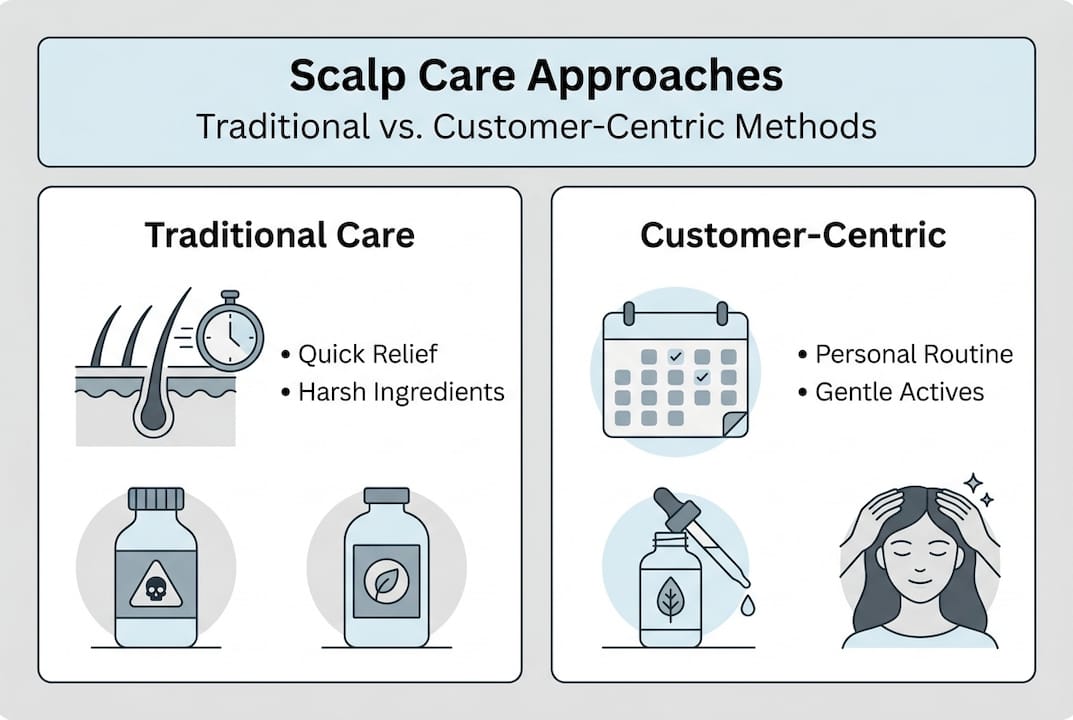
The result is a familiar cycle. Flakes reduce, you stop using the product, flakes return worse than before. This is not a failure of willpower. It is a predictable biological response to repeated chemical disruption.
Visible flake reduction within 24 hours may be achievable with microbiome-friendly leave-on treatments, which challenges the assumption that only strong medicated shampoos deliver fast results.
Understanding how to manage an oily scalp microbiome is particularly relevant here. Excess sebum feeds Malassezia overgrowth, but stripping the scalp with daily harsh shampoos triggers even more oil production as a compensatory response.
Pro Tip: If your scalp feels tight or dry after washing, that is a signal your current shampoo is disrupting the acid mantle. A pH-balanced, low-frequency routine will help restore comfort without the rebound.
Key differences worth noting:
- Customer-centric care uses targeted actives such as salicylic acid, peptides, and prebiotic ingredients rather than broad-spectrum antifungals
- Treatment frequency is reduced deliberately to allow the scalp to recover between applications
- Results are tracked over weeks, not just days, to assess genuine microbiome improvement
- Understanding anti-dandruff agents helps you choose ingredients that work with your scalp rather than against it
Building an effective customer-centric scalp routine
A practical routine does not need to be complicated. Structure matters more than the number of products you use.
The Prep, Treat, Seal method provides a reliable framework for building a customer-centric routine:
- Prep: Use a gentle, pH-balanced cleanser to remove excess sebum and product build-up without stripping the scalp barrier. Aim for wash frequency that matches your scalp's oil production, not a daily default.
- Treat: Apply a targeted scalp treatment using actives such as peptides, AHAs, or microbiome-supporting ingredients. This step addresses the specific concern, whether that is flaking, itch, or oil imbalance.
- Seal: Finish with a lightweight conditioner or leave-in that supports the scalp barrier without occluding follicles or feeding Malassezia.
Frequency is one of the most important variables. Daily washing may feel necessary but it often works against scalp health. Most people with chronic dandruff benefit from washing two to three times per week with a gentle cleanser, and applying a targeted treatment once weekly or during flare-ups.
Here is a sample routine timeline to set realistic expectations:
| Timeframe | Expected outcome |
|---|---|
| 24 to 48 hours | Visible flake reduction may be possible with leave-on treatment |
| Week 1 to 2 | Reduced itch and scalp tightness |
| Week 3 to 6 | Improved oil regulation and less frequent flares |
| Week 8 to 12 | May support scalp microbiome stabilisation, with reduced treatment frequency needed |
Learning how to treat dandruff naturally alongside a structured routine gives you a broader toolkit that addresses both topical and internal contributors.
Pro Tip: Start by reducing wash frequency by one day per week for two weeks before making any product changes. This single adjustment often produces noticeable improvement in scalp comfort without any new products at all.
Understanding what causes scalp flakes at a biological level helps you make smarter choices about which actives to prioritise in the Treat step. Malassezia affects a significant proportion of people with chronic dandruff, and targeting its growth environment rather than simply suppressing it produces more stable long-term results.
Common pitfalls and how to personalise your scalp care
Even a well-designed routine can underperform if common mistakes are not addressed early.
The most frequent errors when transitioning to customer-centric scalp care include:
- Over-washing: Washing daily strips the scalp's natural oils and disrupts pH, triggering compensatory sebum production and worsening the very conditions you are trying to resolve.
- Switching products too quickly: Changing your entire routine at once makes it impossible to identify what is working. Introduce one change at a time and give it at least two weeks before assessing.
- Using scalp-irritating actives at the wrong concentration: High-strength AHAs or essential oils applied too frequently can inflame the scalp barrier, especially during a flare-up when the skin is already compromised.
- Ignoring internal triggers: Topical care alone rarely resolves chronic dandruff if stress, hormonal fluctuations, or dietary factors are actively driving the condition.
Understanding individual triggers such as stress and hormonal changes is essential for sustainable results and fewer relapses. This is where personalisation moves beyond product selection into lifestyle awareness.
Personalising your routine means keeping a simple log. Note your wash days, products used, stress levels, and diet. After two to four weeks, patterns often become visible. Some people find that flares correlate with high-stress periods. Others notice that certain foods, particularly refined sugars or dairy, precede a worsening of symptoms.
For hormonal fluctuations, timing your deeper treatment applications around your cycle or periods of known hormonal change can reduce the severity of flares significantly.
Pro Tip: Use a simple notes app on your phone to track scalp condition each morning with a quick rating out of ten. After a month, you will have clear data on your personal triggers without any guesswork.
Reviewing dandruff prevention tips alongside your personal log gives you a structured reference point for adjusting your routine as your scalp changes across seasons and life stages. If itch is a persistent issue, understanding the connection between scalp itch and microbiome health adds another layer of clarity to your personalisation process.
The truth about customer-centric scalp care: What most advice gets wrong
Most scalp care guides focus on products. Which shampoo, which serum, which ingredient. That framing misses the point entirely.
True customer-centric care is about process, not products. It is about understanding your scalp's behaviour over time, identifying what disrupts it, and building habits that reduce the need for intervention rather than increase it. The goal is less treatment, not more.
Many people living with chronic dandruff have spent years adding products to their routine, each one promising a solution. The pattern is always the same. Initial relief, followed by rebound, followed by a search for something stronger. This cycle is not caused by the wrong product. It is caused by the wrong framework.
Scalp health for long-term relief is built on consistency and restraint, not aggressive intervention. Comfort and flake control may be visible within 24 hours using the right leave-on treatment. But lasting stability comes from respecting the scalp's ecosystem and giving it the conditions to self-regulate.
Patience and small, consistent changes outperform drastic resets in most cases. That is the uncomfortable truth most advice avoids because it does not sell products. It sells a process.
Discover Victory Serums
Customer-centric care works best when the products you use are designed with the same philosophy in mind: minimal intervention, microbiome compatibility, and structured support.

Victory Serums offers pharmacist-developed formulations built around pH awareness and microbiome science. The microbiome scalp serum delivers fast-acting relief as a leave-on or rinse-off treatment, applied weekly or during flare-ups rather than daily. For intensive targeted support, the dandruff control intensive scalp serum addresses persistent flaking and scalp imbalance with a concentrated microbiome-friendly formula. For a full view of targeted scalp concern solutions, the full range is available to explore based on your specific needs and routine stage.
Frequently asked questions
How quickly can you see results from microbiome-friendly scalp care?
Visible flake reduction may be possible within 24 hours using a leave-on microbiome-friendly treatment, with ongoing microbiome rebalancing continuing over several weeks.
Is customer-centric scalp care suitable for severe dandruff?
Yes. Customer-centric routines are specifically designed to personalise care for chronic or severe cases by addressing individual triggers rather than applying a generic solution.
Should I stop using traditional anti-dandruff shampoos immediately?
A gradual transition is recommended. Sudden changes can upset the scalp's microbial balance and cause a temporary flare, so reducing frequency slowly produces better outcomes.
What makes scalp care 'customer-centric'?
It means assessing your individual triggers and needs rather than following a generic regimen, and building a routine that responds to how your scalp actually behaves.
Recommended
- What Are Clinical Scalp Treatments? A 2026 Guide – Victory Serums
- Oily scalp management guide for microbiome balance in 2026 – Victory Serums
- Why Scalp Care Differs from Hair Care – Microbiome Insights – Victory Serums
- Fast Acting Dandruff Relief for Oily Scalp in 2026 – Victory Serums

Get the free 1-Week Guide to Scalp Health and uncover the real cause of your flakes.
Download the free guide
Matt Heron is the founder of Victory Serums, an Australian microbiome focused scalp care brand specialising in severe dandruff, yeast imbalance and chronic scalp instability. With more than four decades of personal experience managing persistent dandruff and extensive study of scalp biology, skin pH and barrier function, he developed targeted scalp serums that work within minutes or as leave in treatments. His Reset, Rebalance and Restore approach challenges daily anti-dandruff shampoo dependence and is helping redefine the way chronic dandruff is treated.