

Updated July 2026
Dandruff affects nearly 50% of adults worldwide, yet most people still treat it as a hygiene problem or a simple dryness issue. Neither is accurate. Beneath the scalp's surface, a complex community of bacteria and yeast governs whether your skin cells shed normally or clump into visible flakes. Science has shifted how we understand this condition, moving away from surface-level symptom control toward the biology that actually drives it. For Australians living with chronic dandruff or persistent scalp irritation, that shift matters. The solutions that work long-term look very different from the ones lining most supermarket shelves.
Table of Contents
- What is dandruff? Debunking myths and outlining the facts
- The science of scale: how scalp microbiome triggers dandruff
- What triggers a flare-up? Stress, immunity and daily habits
- Long-term relief: microbiome-friendly scalp care explained
- Why gentle correction, not chemical warfare, is the future of dandruff control
- Discover Victory Serums
- Frequently Asked Questions
- Recommended
Key Takeaways
| Point | Details |
|---|---|
| Dandruff is microbiome-driven | Malassezia yeast and scalp bacteria imbalances, not hygiene, underlie most chronic dandruff. |
| Long-term relief needs gentle care | Sustainable management relies on microbiome-supportive, low-pH products, not harsh chemicals. |
| Triggers vary person to person | Stress, hormones, and even treatment changes can spark symptoms, so individual tracking matters. |
| Herbal remedies are evidence-informed | Plant-based actives like tea tree oil have shown results comparable to medicated shampoos in some trials. |
| Prevention is a daily habit | Regular gentle scalp care helps maintain balance, reduce flares, and support overall scalp health. |
What is dandruff? Debunking myths and outlining the facts
Two myths dominate public understanding of dandruff. First, that it signals poor hygiene. Second, that it is simply dry skin. Both are wrong. Dandruff is a biological process driven by accelerated skin cell turnover, not a reflection of how often you wash your hair.
In a healthy scalp, skin cells renew roughly every 21 to 28 days. In a dandruff-prone scalp, that cycle compresses to as little as 5 to 14 days. Cells shed faster than they can separate properly, clumping together as the visible white or yellowish flakes most people recognise. Irritation, redness, and an oily or itchy scalp often accompany this process.
The scale of the problem is significant. Around 50% of adults in Australia are believed to experience dandruff or seborrhoeic dermatitis at some point. Australian healthcare guidelines currently recommend anti-yeast shampoos as the first-line treatment approach for most cases.
Common dandruff myths worth correcting:
- Myth: Dandruff is caused by not washing your hair enough.
- Fact: Overwashing can disrupt the scalp's natural balance and worsen symptoms.
- Myth: Dandruff is just dry skin.
- Fact: Dandruff-prone scalps are often oily, not dry. The flaking is driven by microbial activity and inflammation.
- Myth: Dandruff is contagious.
- Fact: It is not. It is a condition influenced by your individual biology and microbiome.
| Feature | Dry skin | Dandruff |
|---|---|---|
| Flake appearance | Fine, white | Larger, oily, yellowish |
| Scalp condition | Tight, dry | Often oily or inflamed |
| Primary driver | Moisture loss | Microbial imbalance |
| Responds to moisturising serum | Often yes | Rarely |
Dandruff is not a hygiene issue. It is a microbiome and skin biology issue, and treating it as anything else tends to lead to the wrong solutions.
For a broader look at the biology behind this condition, science-backed scalp insights offer a useful starting point.
The science of scale: how scalp microbiome triggers dandruff
The scalp hosts a diverse ecosystem of bacteria, fungi, and other microorganisms. When that ecosystem is balanced, it supports a healthy skin barrier and normal cell turnover. When it tips out of balance, dandruff follows.
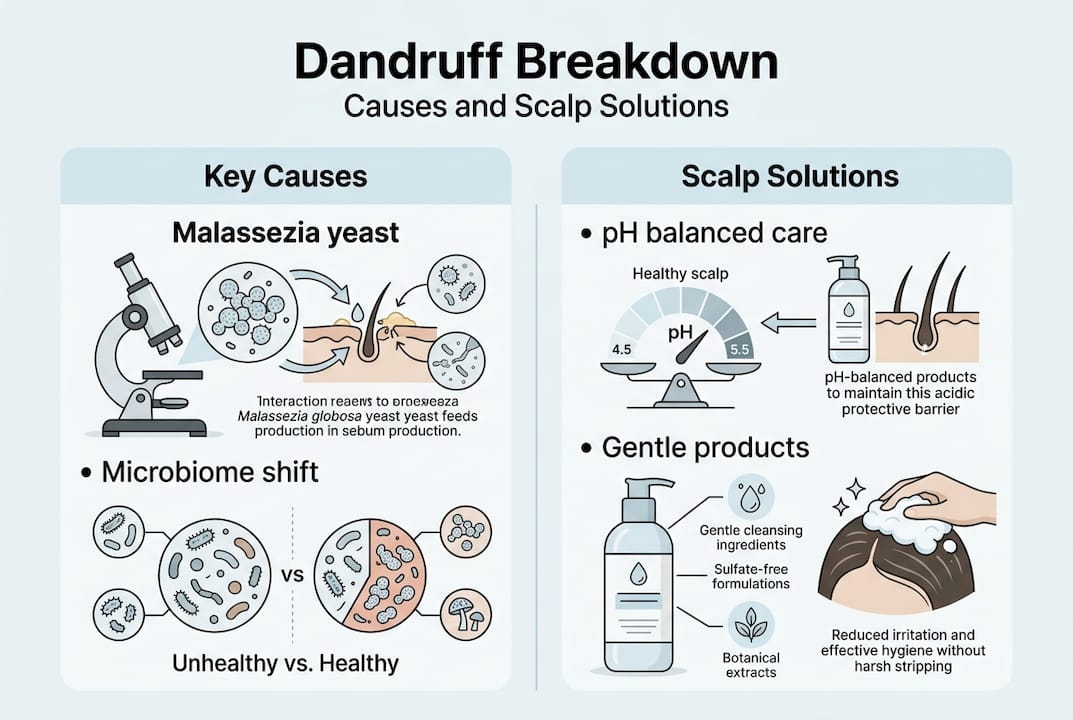
The central player is Malassezia, a genus of yeast naturally present on most human scalps. The problem begins when it overgrows. Malassezia metabolises scalp sebum into irritating fatty acids, which trigger inflammation, compromise the skin barrier, and accelerate cell shedding. The result is the flaking and itching most people associate with dandruff.
Research identifies a specific pattern of disruption. Microbiome dysbiosis in dandruff-prone scalps involves elevated levels of Malassezia globosa and M. restricta, increased Staphylococcus, and reduced populations of beneficial Cutibacterium. This imbalance drives barrier breakdown, oxidative stress, and sustained inflammation.
Healthy scalp vs dandruff-prone scalp:
| Factor | Healthy scalp | Dandruff-prone scalp |
|---|---|---|
| Malassezia levels | Balanced | Elevated |
| Cutibacterium levels | Present, protective | Reduced |
| Skin barrier | Intact | Compromised |
| Cell turnover rate | 21 to 28 days | 5 to 14 days |
| Inflammation markers | Low | Elevated |
Not everyone with Malassezia on their scalp develops dandruff. Individual biology plays a significant role. Factors that may increase susceptibility include:
- Genetic predisposition to immune sensitivity
- Higher sebum production (more fuel for Malassezia)
- Hormonal fluctuations, particularly androgens
- Chronic stress and its impact on immune regulation
- Age, with peaks in adolescence and again after 55
The connection between Malassezia and scalp flakes is well established. Understanding microbiome balance techniques is the logical next step for anyone managing chronic symptoms.
What triggers a flare-up? Stress, immunity and daily habits
Knowing that Malassezia is involved explains the biology. But it does not explain why your scalp can be calm for months and then suddenly flare. Triggers are the missing piece.
Individual susceptibility varies significantly. Not everyone with Malassezia overgrowth develops dandruff. Genetics, immune function, androgen levels, and stress all influence whether the microbiome tips into dysbiosis. Dandruff is more prevalent in males and peaks in two age groups: 18 to 24 and 55 and older.
Common flare-up triggers include:
- Stress: Cortisol suppresses immune responses, giving Malassezia less resistance to overgrow.
- Hormonal shifts: Androgens increase sebum production, feeding yeast populations.
- Seasonal change: Cold, dry air or increased indoor heating alters scalp moisture and pH.
- Dietary patterns: High sugar and refined carbohydrate intake may promote yeast activity.
- Stopping anti-dandruff products: Symptoms can return in as little as 3 days after discontinuing anti-dandruff shampoo, as Malassezia density rebounds rapidly.
That last point is critical. Most conventional anti-dandruff shampoos suppress symptoms while you use them. Stop using them, and the scalp has no self-regulating capacity left. The dependency cycle restarts almost immediately.
Pro tip: Keep a simple scalp diary for two to four weeks before changing any product or routine. Note wash frequency, stress levels, diet, and symptom severity. Patterns emerge quickly and give you real data to act on rather than guesswork.
Managing oily scalp conditions and applying consistent dandruff prevention strategies both become more effective once you know your personal triggers.
Long-term relief: microbiome-friendly scalp care explained
Suppressing symptoms is not the same as resolving the underlying imbalance. Long-term relief requires a different approach: supporting the scalp's own regulatory capacity rather than overriding it with daily chemical intervention.
The evidence for gentler, targeted ingredients is growing. 5% tea tree oil shampoos have been shown to reduce dandruff severity by 41% in some clinical trials. Neem and eucalyptus oils also demonstrate meaningful activity against Malassezia and Staphylococcus without the broad disruption caused by synthetic antifungals used daily.
A 41% reduction in dandruff severity was observed with consistent use of 5% tea tree oil shampoo in some trials, with results comparable to certain synthetic antifungal treatments.
Polyherbal formulations, when used consistently, may perform comparably to ketoconazole-based options while preserving more of the scalp's microbial diversity. Microbiome-friendly approaches can restore bacterial diversity, reduce oxidative stress, and support the skin barrier for sustained remission rather than temporary relief.
A practical, stepped approach to microbiome-supportive scalp care:
- Identify and reduce triggers before adding new products. Less intervention is often more effective.
- Use targeted actives intermittently, not daily. Weekly or as-needed application of stronger treatments reduces dependency risk.
- Maintain scalp pH between 4.5 and 5.5 with low-pH maintenance products used in small volumes.
- Reduce product volume over time. The goal is a scalp that self-regulates, not one that requires constant management.
- Support from within. Gut health and food trigger identification contribute to scalp microbiome stability.
Pro tip: When choosing products, look for a pH of 4.5 to 5.5 on the label or product page. Products formulated without sulphates or synthetic fragrance are less likely to disrupt the scalp's natural bacterial balance.
For deeper reading, sustainable dandruff relief, natural microbiome-safe remedies, and the scalp pH balance guide all provide practical next steps grounded in current research.
Why gentle correction, not chemical warfare, is the future of dandruff control
Most dandruff advice focuses on what to apply. Rarely does it ask what to stop doing. That is where conventional thinking falls short.
Harsh antifungal shampoos used daily do not just target Malassezia. They alter the entire scalp environment, stripping beneficial bacteria alongside problematic ones. Over time, the scalp loses its ability to self-regulate. The result is a scalp that becomes more dependent on intervention, not less.
The mounting evidence points in a different direction. Gentle, intermittent correction. Low-pH formulations used sparingly. Targeted actives applied only when needed. Patience to let the scalp rebalance between treatments.
This is not a passive approach. It requires more attention and consistency than daily shampooing. But it produces a fundamentally different outcome: a scalp that becomes progressively more stable rather than progressively more reactive.
For Australians managing chronic dandruff, the most important shift is in expectation. Results take weeks, not days. And the measure of success is not just clear shoulders today. It is fewer flare-ups, less product needed, and a scalp that responds less dramatically to the triggers that once set it off entirely.
Pro tip: If you are transitioning away from daily anti-dandruff shampoo, reduce frequency gradually rather than stopping abruptly. This gives your scalp microbiome time to begin self-regulating rather than experiencing a sudden rebound.
Discover Victory Serums
The science is clear. Long-term scalp health comes from restoring balance, not from daily chemical suppression. Victory Serums is built on exactly that principle, offering a pharmacist-informed range designed for minimal, targeted use rather than ongoing dependency.
The microbiome-safe scalp serum and microbiome-friendly conditioning shampoo are pH-aware and formulated to work with your scalp's biology, not against it. The full range of dandruff control solutions supports the Reset, Rebalance, Restore framework: fast-acting relief when you need it, and gentle maintenance to build long-term resilience. Download the free 1-Week Scalp Health Guide to start the programme with structured, data-driven support.

Frequently Asked Questions
What actually causes dandruff to flare up suddenly?
Most flare-ups are triggered by stress, hormonal shifts, immune changes, or stopping anti-dandruff products. Malassezia density can rebound within three days of discontinuing treatment, which is why symptoms may return so quickly.
Are herbal or microbiome-friendly shampoos as effective as chemical options?
Some polyherbal shampoos have performed comparably to ketoconazole-based products in clinical trials while preserving more of the scalp's beneficial microbial diversity. Results vary by formulation and individual scalp type, so consistent use over several weeks is needed to assess effectiveness.
Why does dandruff keep coming back after treatment?
Dandruff involves persistent microbiome vulnerability combined with ongoing external triggers. Most conventional treatments suppress symptoms rather than restore the scalp's self-regulating capacity, which is why relapses are common when treatment stops. A microbiome-supportive approach aims to reduce that dependency over time.
How can I make my scalp more resilient to dandruff?
Consistent use of microbiome-friendly, pH-balanced products combined with stress management, dietary awareness, and reduced product frequency supports the scalp's natural self-regulation over time. Tracking your personal triggers is one of the most practical steps you can take.
FAQ
What actually causes dandruff?
Dandruff is not a hygiene problem or simple dryness. It is driven by the scalp microbiome, a community of bacteria and yeast that governs whether skin cells shed normally or clump into visible flakes.
What triggers a dandruff flare-up?
Common triggers include stress, immune response, and daily habits that disturb the scalp environment, tipping the microbiome out of balance and prompting flaking.
How do you get long-term relief from dandruff?
Long-term relief comes from microbiome-friendly scalp care that gently corrects the imbalance, rather than chemical suppression that strips the scalp and invites the problem back.
Is dandruff just dry skin?
No. It is a microbiome-driven condition, which is why moisturising alone rarely resolves it and why matching treatment to the real cause matters.
Recommended
- Why Does Dandruff Occur? Science-Backed Scalp Insights 2026 – Victory Serums
- What causes scalp flakes? Malassezia affects 80% of cases – Victory Serums
- Best natural remedies for dandruff 2026: microbiome safe – Victory Serums
- Understanding anti-dandruff agents: sustainable relief – Victory Serums

Get the free 1-Week Guide to Scalp Health and uncover the real cause of your flakes.
Download the free guide
Matt Heron is the founder of Victory Serums, an Australian microbiome focused scalp care brand specialising in severe dandruff, yeast imbalance and chronic scalp instability. With more than four decades of personal experience managing persistent dandruff and extensive study of scalp biology, skin pH and barrier function, he developed targeted scalp serums that work within minutes or as leave in treatments. His Reset, Rebalance and Restore approach challenges daily anti-dandruff shampoo dependence and is helping redefine the way chronic dandruff is treated.