
Updated July 2026
Dandruff is not simply a dry scalp problem. For millions of Australians dealing with persistent flaking and irritation, the real issue runs deeper, sitting within the scalp's own invisible ecosystem. Science now points clearly to the scalp microbiome, the unique community of bacteria, fungi, and other microorganisms living on your scalp, as a central driver of chronic scalp trouble. Scalp probiotics, both topical and oral, are emerging as a genuinely promising way to restore that balance. This guide explains what they are, how they work, and what the clinical evidence actually shows.
Table of Contents
- Understanding the scalp microbiome and its role in irritation
- How scalp probiotics work: science and solutions
- Forms and use: applying probiotics to the scalp (and gut)
- The evidence so far: benefits and limitations of scalp probiotics
- An expert view: scalp probiotics in the real world
- Discover Victory Serums
- Frequently Asked Questions
- Recommended
Key Takeaways
| Point | Details |
|---|---|
| Microbiome matters | A healthy scalp microbiome is vital for controlling dandruff and chronic irritation. |
| Probiotics restore balance gradually | Evidence supports topical probiotics for microbiome restoration over 8 to 12 weeks of consistent use. |
| Scalp serums offer targeted fast relief | Targeted scalp serums can calm symptoms almost immediately and work alongside probiotic restoration. |
| Adjunct, not a cure-all | Scalp probiotics are best used alongside antifungals and gentle care, not as a solo remedy. |
| Personalisation is key | Results improve with routines tailored to individual triggers, microbiome status, and product type. |
Understanding the scalp microbiome and its role in irritation
The scalp is not just an extension of your facial skin. It carries a far higher density of hair follicles and sebaceous glands, which produce sebum (natural oil). This makes it a uniquely rich environment for microbial life. The Australian scalp microbiome balance is shaped by factors including climate, diet, genetics, and the products you use daily.
A healthy scalp microbiome is diverse. Bacteria such as Cutibacterium and Staphylococcus species coexist with fungi like Malassezia, keeping each other in check. Problems start when this balance breaks down, a state called dysbiosis. When dysbiosis occurs, Malassezia can overgrow rapidly. This yeast feeds on scalp oils and produces irritating byproducts that trigger inflammation, flaking, and itch. Understanding the difference between scalp vs hair care microbiome needs matters here, because most commercial shampoos are formulated for hair, not for the scalp's microbial ecosystem.
Common triggers for dysbiosis include:
- Harsh sulphate-based shampoos that strip the scalp's acid mantle
- Overuse of antifungal products, which can reduce microbial diversity
- High-sugar or high-fat diets that may feed Malassezia
- Stress, which alters sebum production and immune response
- Hormonal fluctuations
Dysbiosis is linked to Malassezia overgrowth, inflammation, flaking, and itching. This reframes dandruff entirely. It is not a hygiene failure. It is a microbiome imbalance.
Dandruff is believed to affect up to 50% of the global population at some point in their lives. The evidence consistently links it to microbial dysbiosis, not to how often someone washes their hair.
This is why dandruff microbiome tips that focus on restoring balance, rather than simply suppressing symptoms, are gaining traction among health-conscious Australians.
How scalp probiotics work: science and solutions
Scalp probiotics are live or inactivated beneficial microorganisms applied to, or consumed to benefit, the scalp environment. They work differently from antifungal shampoos. Rather than killing pathogens directly, they restore competitive balance within the microbiome.
There are three key categories worth knowing:
- Probiotics: Live beneficial microbes (bacteria or yeast) that colonise and compete with pathogens
- Postbiotics: Byproducts or inactivated forms of beneficial microbes that still deliver biological benefits
- Prebiotics: Substrates that selectively feed beneficial microbes already present on the scalp
Beneficial microbes work through several mechanisms. They compete with Malassezia for nutrients and attachment sites on the scalp. They produce antimicrobial peptides (AMPs), short proteins that may inhibit pathogen growth. They can also help regulate scalp pH, nudging it back toward the optimal acidic range of 4.5 to 5.5, which naturally discourages fungal overgrowth.
It is important to distinguish between two different strategies here. Targeted scalp serums, such as those used in the 1-Week Scalp Health Guide, are designed to deliver fast, direct relief and can calm flaking and irritation almost immediately. Probiotic-based microbiome restoration is a longer process, with studies showing meaningful improvements in microbial diversity and symptom reduction over 8 to 12 weeks of consistent use. Both have a role, but they operate on different timescales.
The clinical evidence for scalp serum use as a targeted relief strategy is well established. Topical probiotics may also reduce dandruff flakes and itching over time, complementing the immediate calming effect of a well-formulated serum.
| Mechanism | What it does |
|---|---|
| Competitive exclusion | Beneficial microbes outcompete Malassezia for space and nutrients |
| Antimicrobial peptide production | May inhibit pathogen growth without broad-spectrum chemical suppression |
| pH regulation | Restores acidic scalp environment that discourages fungal overgrowth |
| Barrier support | Strengthens the scalp's skin barrier, reducing moisture loss and irritation |
| Immune modulation | May reduce inflammatory signalling that drives itch and redness |
Pro tip: When choosing a microbiome-friendly scalp serum, look for formulations with a pH below 5.5. Products formulated above this range may inadvertently support fungal growth, even if they contain beneficial ingredients.
Forms and use: applying probiotics to the scalp (and gut)
Knowing how these beneficial microbes work leads naturally to the question of how to incorporate them into your routine. The options are broader than most people realise.
Types of probiotic products available:
- Topical serums containing live or heat-killed probiotic strains
- Probiotic-infused shampoos (note: live strains may not survive rinsing)
- Leave-in scalp treatments with postbiotic actives
- Oral probiotic supplements targeting the gut-skin axis
Clinical studies suggest that topical B. lactis, heat-killed L. paracasei, and oral probiotics can improve scalp symptoms and hair density over time. This means both topical and internal approaches may have a role to play in a structured program.
Understanding why dandruff occurs helps you choose the right delivery method. If your triggers are primarily dietary or stress-related, oral probiotics that support the gut-skin axis may be a useful addition alongside a targeted serum for immediate symptom control.
A practical routine combining serums and scalp probiotics:
- Start with a gentle, low-pH shampoo to cleanse without stripping the scalp
- Apply a targeted scalp serum to dry or towel-dried scalp for fast, direct relief
- Use a probiotic or postbiotic leave-in treatment 2 to 3 times per week to support microbiome restoration
- Track changes in flaking, itch, and oiliness over 8 to 12 weeks to monitor microbiome progress
- Adjust product volume downward as your scalp stabilises
For oily scalp microbiome tips, the approach differs slightly. Oily scalps provide more substrate for Malassezia, so frequency and formulation choice matter more.
Pro tip: Oral probiotic supplements are most useful when scalp issues coincide with digestive symptoms, food sensitivities, or a history of antibiotic use. These are signs the gut-skin axis may be contributing to your scalp's behaviour.
Key probiotic strains with scalp evidence:
- Lactobacillus paracasei (heat-killed): may reduce Malassezia colonisation
- Bifidobacterium lactis: supports barrier function and may reduce inflammation
- Lactobacillus rhamnosus: oral use linked to reduced inflammatory skin conditions
The evidence so far: benefits and limitations of scalp probiotics
With practical options in mind, it is worth weighing what the science actually shows, and where the honest limits lie.
The benefits recorded in clinical settings are meaningful:
- Significant reduction in flake severity and scalp itch
- Improved microbial diversity after consistent use
- Hair density improvements of up to 30% reported in some trials
- Better quality-of-life scores in participants with chronic dandruff
- Fewer relapses compared to aggressive antifungal treatments
Scalp serums vs scalp probiotics vs conventional treatments
| Factor | Antifungal shampoos | Targeted scalp serums | Scalp probiotics |
|---|---|---|---|
| Speed of action | Fast (days to weeks) | Fast (near immediate relief) | Gradual (8 to 12 weeks) |
| Mechanism | Kills or suppresses fungi | Targeted symptom calming | Restores microbial balance |
| Relapse rate | Higher with long-term use | Managed with structured use | Lower in sustained use |
| Microbiome impact | Reduces diversity | Neutral to supportive | Supports diversity |
| Safety profile | Can cause irritation | Generally well tolerated | Generally well tolerated |
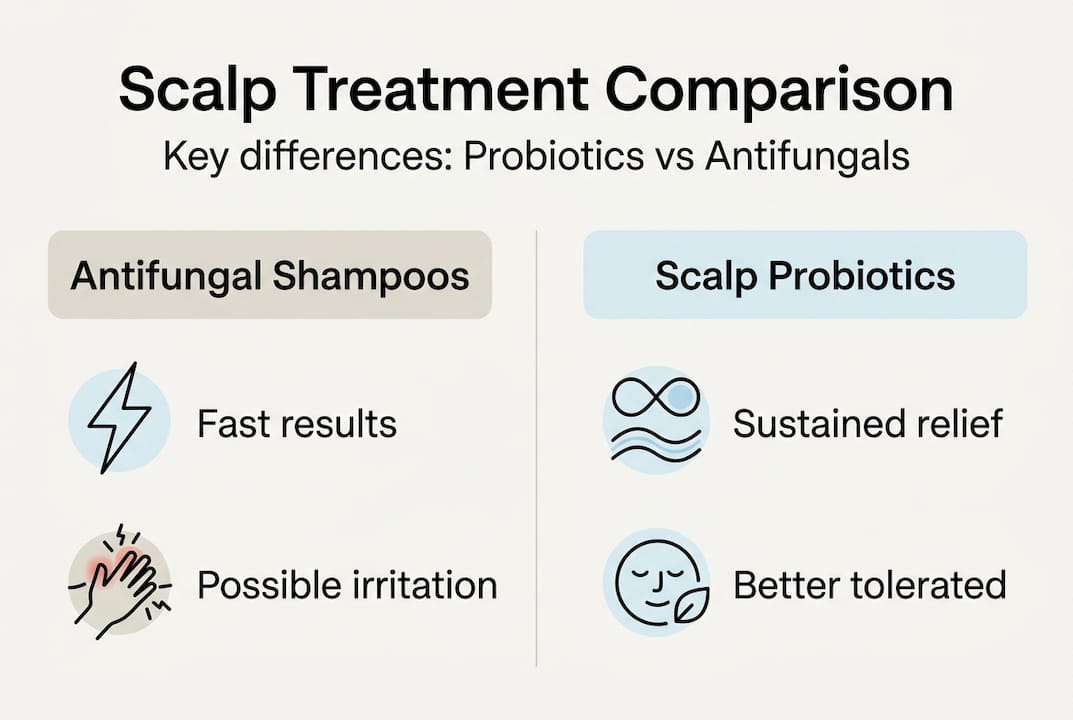
The safety profile of scalp probiotics is one of their clearest advantages. They are generally better tolerated than topical steroids and do not carry the same risk of resistance that antifungal agents can produce over time.
That said, limitations exist. Emerging but limited large-scale trials mean that probiotics are best used as an adjunct to conventional treatments, particularly for persistent or severe cases, rather than as a standalone first-line therapy. A targeted scalp serum remains the most practical starting point for immediate relief while microbiome restoration progresses in the background.
For context on what drives Malassezia and scalp flakes in Australian conditions, the evidence points to a combination of climate, diet, and product habits, all of which probiotics alone cannot fully address.
Key stat: Some trials report up to 30% improvement in hair density alongside symptom reduction, suggesting probiotics may support the scalp environment beyond dandruff control alone.
For those seeking sustainable dandruff relief, the evidence supports a combined approach: targeted scalp serums for fast symptom control, antifungals for acute flare-ups, and probiotics with prebiotics for ongoing microbiome restoration.
An expert view: scalp probiotics in the real world
The published evidence is genuinely promising. But real-world outcomes depend on factors that no clinical trial fully captures.
Strain selection matters enormously. Not every probiotic product contains strains with scalp-specific evidence. Many products use strains studied for gut health and assume the benefits transfer topically. That assumption is not always supported.
Delivery form is equally important. Live strains in a rinse-off shampoo may not survive long enough to colonise. Leave-in serums and heat-killed postbiotics tend to deliver more consistent results in practice.
Underlying triggers are the most overlooked factor. Probiotics will not override a diet high in refined sugars, a chronic stress load, or a hormone imbalance that is actively driving sebum overproduction. Addressing these alongside topical treatment is what separates short-term relief from lasting change.
The most practical starting point for most people is a targeted scalp serum that delivers fast, direct relief while the slower work of microbiome restoration gets underway. For Australians navigating chronic scalp issues, combining clinical scalp treatment guidance with personalised tracking, dietary awareness, and a structured reduction in overall product use over time gives the best long-term outcome. Probiotics are a valuable tool. They are not a single solution.
Pro tip: If you are starting with scalp probiotics, track your flaking, itch, and oiliness weekly for the first 12 weeks. This data helps you identify whether the product is working and when to reduce frequency, rather than guessing based on day-to-day variation.
Discover Victory Serums
Evidence-based scalp care does not have to be complicated. Victory Serums offers a pharmacist-informed range built around microbiome compatibility, pH awareness, and minimal chemical interference. For Australians managing chronic dandruff or scalp irritation, the approach combines fast-acting targeted serums with a structured pathway to long-term microbiome balance.
The Dandruff Control Intensive Scalp Serum is designed to calm symptoms quickly, working as a targeted relief strategy from the first application. The full scalp dandruff control range then supports ongoing microbiome restoration without creating a new daily dependency. For a structured, science-informed starting point, the free 1-Week Scalp Health Guide is available free and outlines the Reset, Rebalance, Restore framework used by Australians working toward lasting scalp relief.

Frequently Asked Questions
Are scalp probiotics safe for long-term use?
Current research indicates scalp probiotics are generally safe and well tolerated. They present a lower-risk option for ongoing scalp maintenance compared to topical steroids and are associated with fewer relapses than aggressive antifungal treatments.
How quickly do scalp serums and probiotics work for dandruff?
Targeted scalp serums can calm flaking and irritation almost immediately, making them the most practical first step for fast relief. Probiotic-based microbiome restoration operates on a longer timeline, with studies supporting meaningful improvements in microbial balance over 8 to 12 weeks of consistent use. The two strategies work well together.
Can I use probiotics instead of antifungal shampoos?
In severe cases, probiotics are best used alongside rather than instead of antifungal shampoos. They are most effective as an adjunct or maintenance tool rather than a first-line treatment for significant fungal overgrowth.
Do oral probiotics affect scalp health?
Oral probiotics can reduce systemic inflammation and may improve scalp symptoms through the gut-skin axis. Early clinical trials have shown improvements in hair density alongside symptom reduction, though more large-scale research is needed.
FAQ
What are scalp probiotics?
They are topical or oral products intended to support the scalp microbiome, the community of bacteria and fungi living on your scalp that influences flaking and irritation.
Do scalp probiotics actually work?
The evidence is promising rather than conclusive. They work by supporting microbial balance instead of stripping it, which can help chronic flaking driven by an imbalanced scalp.
Are topical or oral probiotics better for the scalp?
Both forms are emerging. Topical products act directly on the scalp environment, while oral probiotics work through the wider microbiome. The best approach supports balance rather than relying on either alone.
Is dandruff just a dry scalp problem?
No. For many people the real driver sits in the scalp microbiome, not simple dryness, which is why moisturising alone often fails.
Recommended
- Oily scalp management guide for microbiome balance in 2026 – Victory Serums
- Scalp pH Balance Guide: Restore Microbiome Harmony 2026 – Victory Serums
- Australian scalp care: microbiome balance for 2026 – Victory Serums
- Why Does Dandruff Occur? Science-Backed Scalp Insights 2026 – Victory Serums

Get the free 1-Week Guide to Scalp Health and uncover the real cause of your flakes.
Download the free guide
Matt Heron is the founder of Victory Serums, an Australian microbiome focused scalp care brand specialising in severe dandruff, yeast imbalance and chronic scalp instability. With more than four decades of personal experience managing persistent dandruff and extensive study of scalp biology, skin pH and barrier function, he developed targeted scalp serums that work within minutes or as leave in treatments. His Reset, Rebalance and Restore approach challenges daily anti-dandruff shampoo dependence and is helping redefine the way chronic dandruff is treated.