

Updated July 2026
In Brief:
- Well-formulated natural treatments can match medicated shampoos for mild to moderate dandruff.
- The practical approach is medicated during flares, then natural for maintenance.
- Tea tree and neem are microbiome-friendly options with genuine antifungal activity.
Many Australians with chronic dandruff assume only medicated shampoos deliver real results. That assumption is being challenged. Well-formulated natural treatments can match medicated options for most people with mild to moderate dandruff. The real question is not which camp is superior, but which approach suits your scalp, your situation and your long-term goals. This guide breaks down the science behind both, compares their safety profiles, and gives you a framework for making better decisions.
How medicated and natural treatments work
Dandruff is primarily driven by an overgrowth of Malassezia, a yeast that lives naturally on the scalp. Both approaches aim to control that overgrowth, but they take very different routes.
Medicated shampoos rely on synthetic antifungals. Ketoconazole, zinc pyrithione and selenium sulphide disrupt fungal cell membranes and inhibit Malassezia directly. That reduces flaking, itching and inflammation relatively quickly, and these ingredients are the backbone of most pharmacy-brand products in Australia.
Natural treatments work differently. Plant extracts like neem, tea tree oil, tulsi and aloe vera contain compounds that deliver antifungal, anti-inflammatory and sebum-regulating effects without the broad-spectrum activity that disturbs the scalp's beneficial bacteria. That distinction matters. A scalp that retains its healthy bacterial population is better positioned to resist future flare-ups on its own.
| Feature | Medicated treatments | Natural treatments |
|---|---|---|
| Primary target | Malassezia | Malassezia and inflammation |
| Key actives | Ketoconazole, zinc pyrithione | Neem, tea tree oil, aloe vera |
| Mechanism | Disrupts fungal cell membranes | Plant-derived antifungal action |
| Microbiome impact | Can reduce beneficial bacteria | Generally microbiome-friendly |
| Speed of action | Fast, especially for severe cases | Moderate, better for ongoing use |
Pro Tip: Not every product labelled natural is effective. Look specifically for evidence-backed ingredients like tea tree oil or neem rather than relying on marketing terms.
Comparing effectiveness: what does the science say?
The herbal versus synthetic comparison tells a more interesting story than most people expect. Controlled trials show well-made herbal shampoos can match ketoconazole and zinc pyrithione formulas for reducing dandruff severity, scaling, redness and itching over 30-day study periods, with no statistically significant difference between groups.
For severe or sudden flares, medicated formulas still act faster. The stronger antifungal activity gets symptoms under control more rapidly. But for ongoing use and managing dryness between flares, natural blends often produce a more comfortable result.
Tea tree oil is the clearest example. At a 5% concentration it has been shown in randomised controlled work to meaningfully reduce dandruff severity compared with placebo. That makes it a clinically measurable antifungal agent rather than a folk remedy, and combined with its gentler profile, its appeal for long-term use becomes obvious.
| Measure | Medicated shampoos | Natural or herbal shampoos |
|---|---|---|
| Dandruff severity reduction | High, especially initially | Comparable over 30 days |
| Itch relief | Fast | Moderate to good |
| Dryness management | Can worsen dryness | Generally better for dry scalps |
| Side effect rate | Higher in trials | Lower |
| Microbiome compatibility | Lower | Higher |
| Long-term suitability | Limited by side effects | Better suited for maintenance |
For a practical breakdown of what to use, the best natural dandruff remedies guide covers evidence-backed options.
Side effects and safety

Medicated shampoos carry a real risk profile with prolonged use. Dryness, irritation, hair damage and reduced effectiveness from fungal resistance are all documented. Using them daily for months shifts scalp pH, disrupts microbial balance, and can noticeably alter hair texture.
Natural formulas tend to be gentler and produce fewer adverse effects. They are less likely to strip beneficial bacteria and are generally better tolerated for regular use. In comparative trials, the adverse effects reported cluster heavily on the medicated side. That does not mean medicated products are harmful when used correctly and briefly, but it reinforces the case for limiting strong chemical use to acute phases.
Medicated shampoo risks:
- Scalp dryness and tightness
- Irritation or contact dermatitis
- Changes in hair texture with prolonged use
- Potential fungal resistance over time
- Disruption of the beneficial microbiome
Natural treatment risks:
- Rare allergic reactions to specific plant extracts
- Variable potency depending on formulation quality
- Slower initial action for severe flares
Pro Tip: Rotating between treatment types every few months helps maintain scalp resilience. Staying on a single strong formula indefinitely increases the risk of dependency and resistance.
Choosing the right approach long term
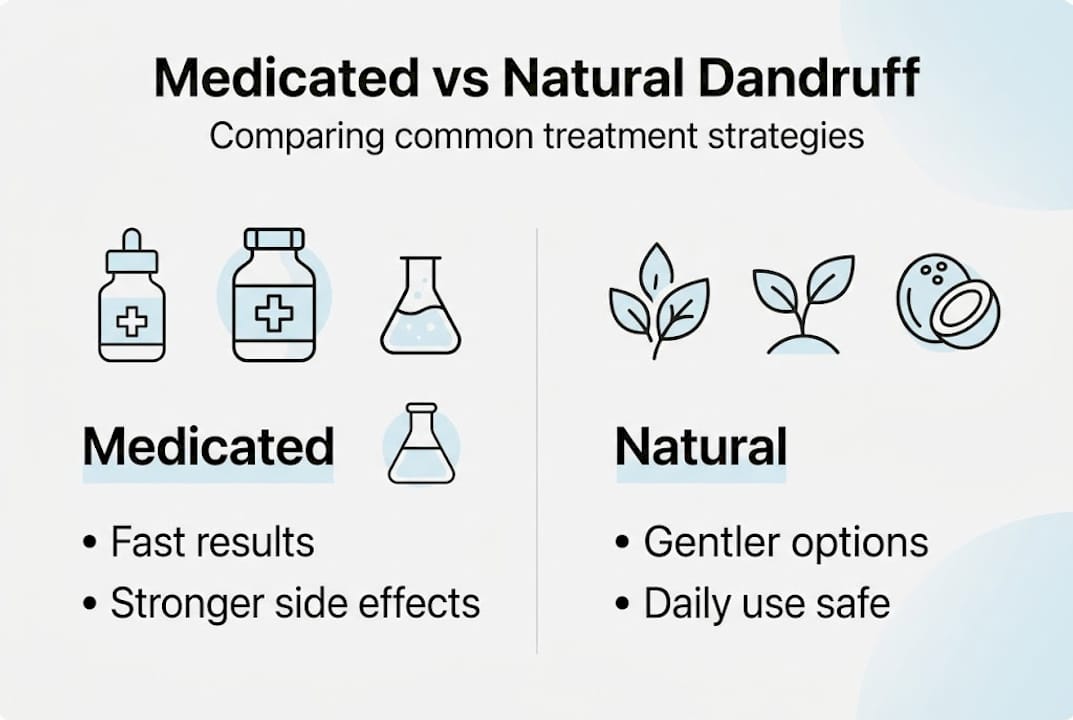
The evidence supports a stepwise approach: start with medicated for active flares, then transition to gentler maintenance formulas. Australian clinical guidance reflects this, with ketoconazole and zinc pyrithione as first-line for seborrhoeic dermatitis and natural options positioned for maintenance once symptoms are controlled.
- During a flare: use a medicated formula to bring symptoms under control quickly. Limit it to the acute phase.
- After symptoms settle: transition to a low-pH, microbiome-friendly formula for maintenance. Prioritise products that name their specific actives.
- Between washes: reduce overall product volume and washing frequency. Overwashing strips the scalp and worsens long-term imbalance.
- Assess lifestyle factors: stress, dietary triggers and washing routine all influence dandruff.
- If symptoms persist: consult a dermatologist. Stubborn dandruff that resists both approaches may indicate an underlying condition.
Pro Tip: Always patch-test new natural products before applying them to the full scalp. Plant extracts like tea tree oil can cause reactions in sensitive individuals even at low concentrations.
Research into the microbiome and dandruff continues to evolve, with new findings reinforcing the case for preserving microbial diversity.
Why "natural vs medicated" is the wrong question
The real pitfall is not choosing the wrong product. It is framing the problem as an either-or decision.
Acute flares genuinely need fast antifungal intervention, and medicated formulas deliver that. But using them indefinitely because they feel reassuring is where the dependency cycle starts. Equally, avoiding all science-backed ingredients out of a fear of chemicals leaves people cycling through ineffective products that never quite resolve the problem.
The stronger approach is strategic and flexible. Use what the scalp needs, when it needs it. Medicated for control, gentler and microbiome-friendly for lasting relief. Individual variation is real: what resolves one person's dandruff may do nothing for another. The goal is self-regulation with minimal chemical interference, not permanent dependence on any single formula.
Looking for a safer dandruff solution?

Victory Serums offers pharmacist-developed scalp care designed around microbiome compatibility and pH awareness. The scalp serum works fast and is designed for minimal, strategic application, and the full dandruff control range supports maintenance without the chemical load of daily medicated use. These are not daily-dependency products. They are tools for a structured approach to long-term scalp health.
Frequently asked questions
Are natural anti-dandruff shampoos as effective as medicated ones?
Well-formulated herbal shampoos can match ketoconazole and zinc pyrithione for reducing dandruff severity and itching over 30 days in controlled trials. For mild to moderate dandruff, they are a clinically supported alternative.
What are the safest ingredients for the scalp microbiome?
Neem, tea tree oil, aloe vera and well-made polyherbal blends tend to control dandruff while preserving beneficial bacteria. These are the most microbiome-compatible actives currently supported by evidence.
Can I use medicated and natural treatments together?
Yes. Start with medicated for active symptom control, then transition to gentler formulas for maintenance. That stepwise approach reduces overall chemical exposure while supporting balance.
Are there risks with long-term medicated shampoo use?
Yes. Dryness, irritation, hair texture changes and reduced effectiveness from resistance are all documented. Limiting use to flare phases reduces these risks significantly.
Victory Serums products are designed to support scalp comfort and scalp health practices. They are not intended to diagnose, treat, cure or prevent medical conditions. If symptoms are severe, persistent, cracked, bleeding or worsening, seek guidance from a qualified healthcare professional.
Recommended
- Understanding anti-dandruff agents: sustainable relief – Victory Serums
- Dandruff treatment step by step for lasting relief – Victory Serums
- Best natural remedies for dandruff 2026: microbiome safe – Victory Serums
- Australian scalp care: microbiome balance for 2026 – Victory Serums

Get the free 1-Week Guide to Scalp Health and uncover the real cause of your flakes.
Download the free guide
Matt Heron is the founder of Victory Serums, an Australian microbiome focused scalp care brand specialising in severe dandruff, yeast imbalance and chronic scalp instability. With more than four decades of personal experience managing persistent dandruff and extensive study of scalp biology, skin pH and barrier function, he developed targeted scalp serums that work within minutes or as leave in treatments. His Reset, Rebalance and Restore approach challenges daily anti-dandruff shampoo dependence and is helping redefine the way chronic dandruff is treated.