
Updated July 2026
In Brief:
- A healthy scalp sits at a pH of 4.5 to 5.5. That mild acidity is what keeps the microbiome balanced and dandruff in check.
- Daily chemical anti-dandruff shampoos disrupt that balance and build dependency. Less product, used with intention, is the way out.
- Australian, pharmacist-developed formulations are designed around pH awareness and the microbiome, not around suppression.
Most Australians assume a daily anti-dandruff shampoo is simply the price of managing flakes. That assumption is exactly what keeps the problem going. Chemical suppression, used day after day, tends to make the underlying imbalance worse, not better. There is another way to approach it, grounded in the scalp microbiome, pH awareness and pharmacist-developed formulation. This guide sets out how that approach addresses the root causes of dandruff rather than masking them.
Understanding scalp health and microbiome basics
The scalp microbiome is the community of bacteria, fungi and other microorganisms that live on your skin. These microbes are not passengers. They maintain barrier function and help regulate inflammation. Among them is Malassezia, a yeast that is naturally present on almost every scalp and only becomes a problem when conditions let it overgrow.
A balanced microbiome keeps Malassezia in check and prevents the irritation and flaking of dandruff. When the environment shifts, through stress, diet or harsh products, that balance collapses. Malassezia overgrowth correlates with dandruff severity in up to 80% of cases, driving inflammation and speeding up skin cell turnover.
The things that most commonly disrupt the balance are worth knowing, because most of them are within your control:
- Overuse of chemical shampoos that strip natural oils and raise pH
- Environmental stress such as UV, pollution and humidity swings
- Internal factors like poor gut health, dietary triggers and hormonal shifts
- Washing too often, or too rarely, which unsettles microbial stability
Understanding what actually causes scalp flakes makes it clear why targeting the environment, rather than just suppressing the symptom, is what produces lasting change.
Why pH balance matters in scalp care
Your scalp is supposed to be slightly acidic, typically between 4.5 and 5.5. That acidity is not incidental. It supports beneficial microbes, holds harmful bacteria and fungi in check, and keeps the scalp barrier intact. The natural scalp pH sits between 4.5 and 5.5, and staying in that band is one of the most reliable things you can do for long-term scalp health.
When pH drifts upward, several things go wrong at once. The barrier weakens and moisture escapes. Beneficial bacteria adapted to acidity decline, and opportunists that tolerate higher pH move in. Most commercial shampoos are alkaline, which is why each wash nudges the scalp further from where it should be.
What acidity does for the scalp:
- Holds Malassezia and other pathogens in check
- Strengthens the lipid barrier and reduces water loss
- Supports the beneficial bacteria that outcompete harmful strains
- Prevents the dryness and sensitivity that alkaline products cause
Choosing products formulated near your scalp's natural range is not optional if you want lasting relief. Understanding how scalp pH works helps you make decisions that support natural balance rather than force artificial control.
Drawbacks of daily chemical anti-dandruff shampoos
Daily use of chemical anti-dandruff shampoos creates a dependency cycle that worsens scalp health over time. These products rely on actives like zinc pyrithione, ketoconazole or selenium sulphide, which suppress the symptom without addressing the imbalance underneath.
Anti-dandruff shampoos that rely on daily chemical suppression disrupt the scalp microbiome, which is how the dependency forms. The scalp comes to rely on the product to control flaking, and when you stop, the symptoms rebound, often worse than before. The more you wash, the more you feel you need to wash.
The common problems with daily chemical shampoos:
- They reduce the diversity of beneficial microbes
- Frequent use brings dryness, irritation and increased sensitivity
- They mask the root cause while the imbalance quietly worsens
- A dependency forms, so stopping triggers a flare
Pro Tip: If your scalp feels worse a few days after stopping a daily anti-dandruff shampoo, dependency has likely formed. Moving to a lower-pH, microbiome-friendly routine takes patience, but it is what breaks the cycle.
Benefits of Australian-made, science-backed scalp care
Products developed in Australia are formulated with the local environment and scalp microbiome in mind. The climate here, with its UV intensity, humidity swings and seasonal shifts, places particular demands on the scalp, and products made locally account for that.
Pharmacist-developed formulations bring precision to pH, ingredient choice and microbiome compatibility. Unlike mass-market products built for global distribution, a microbiome-first Australian approach prioritises minimal chemical interference and long-term resilience. It also treats the scalp as connected to the rest of you, recognising that gut health, diet and systemic factors all play a part.
| Feature | Mainstream anti-dandruff shampoos | Microbiome-friendly approach |
|---|---|---|
| pH level | Often alkaline (above 6) | Formulated low, near the natural range |
| Frequency | Daily or several times a week | Sparingly, as needed during flares |
| Microbiome impact | Disrupts balance, reduces diversity | Supports beneficial microbes |
| Dependency risk | High, symptoms rebound when stopped | Low, guides the scalp to self-regulate |
| Chemical load | Heavy reliance on active suppressants | Minimal chemical interference |
Pro Tip: Look for products that state their pH range. If the label does not mention pH at all, the formulation most likely prioritises symptom suppression over balance.
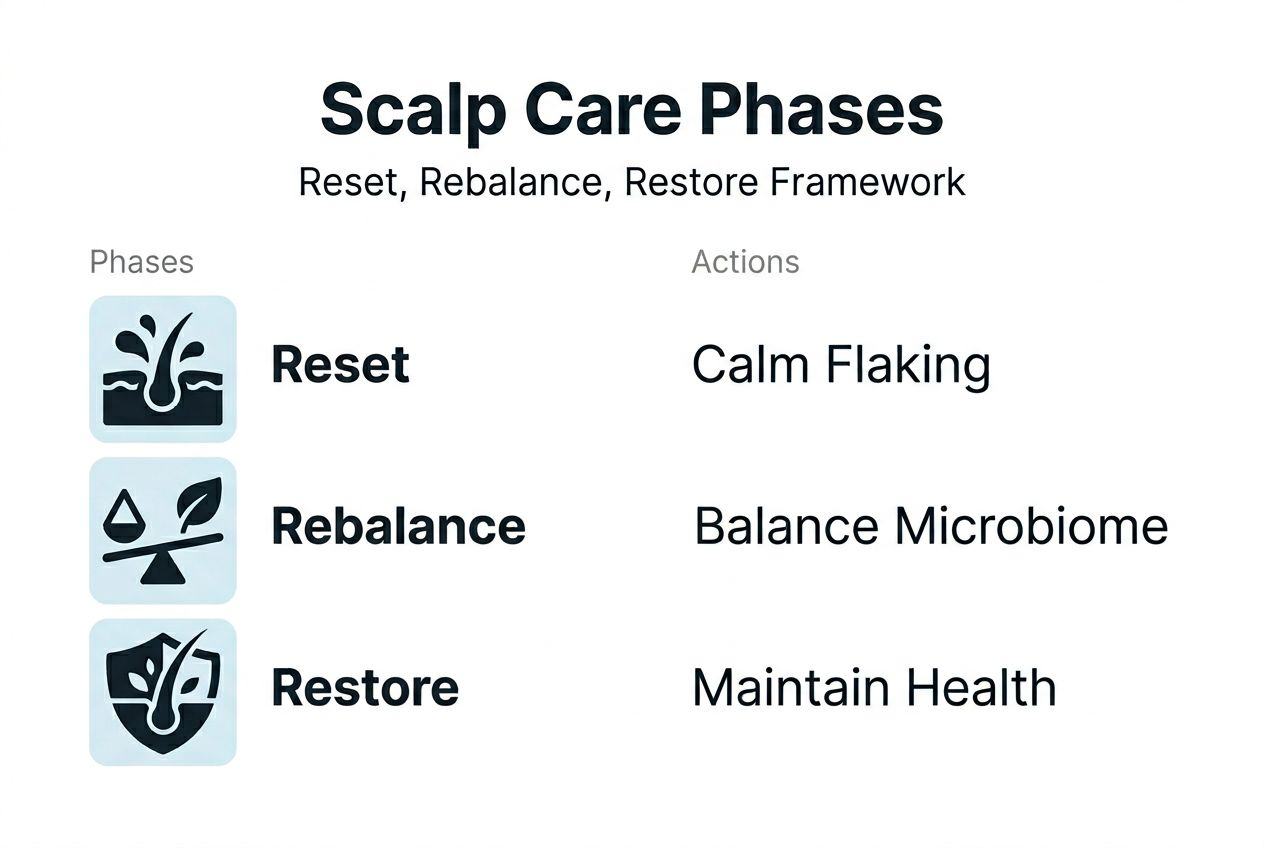
Structured scalp care: Reset, Rebalance, Restore
Effective scalp care follows a structured path that calms the acute flare, stabilises the microbiome, then addresses the systemic factors underneath. The Reset, Rebalance, Restore framework provides that path.
-
Reset: during an active flare, use a targeted scalp serum to calm inflammation and bring Malassezia back under control. Apply it as needed, not daily. The goal is fast relief without building dependency.
-
Rebalance: reduce intervention to a low-pH maintenance routine used sparingly, giving the microbiome room to recover. As symptoms settle, use less.
-
Restore: address the systemic factors, gut health, diet and daily habits, that influence the scalp. Dietary change can meaningfully ease scalp symptoms for some people. Food triggers, stress and microbiome diversity all play a role.
| Phase | Key actions | Approach | Frequency |
|---|---|---|---|
| Reset | Rapid flare control | Targeted scalp serum | As needed |
| Rebalance | Microbiome stabilisation | Low-pH maintenance, minimal use | Reducing over time |
| Restore | Systemic support | Gut health and dietary adjustments | Ongoing lifestyle |
Pro Tip: Track your scalp symptoms, product use and diet in a journal. Patterns emerge over time, and they tell you far more about your triggers than any single product ever will.
The free 1-Week Scalp Health Guide sets out this framework in detail, with step-by-step instructions for each phase.
Common misconceptions about scalp care
All anti-dandruff products are equally effective. They are not. Many commercial shampoos disrupt the scalp microbiome when used daily. Whether a product helps or harms depends on its formulation, its pH and how often you use it.
More frequent shampooing is better for dandruff. Overwashing strips natural oils and disrupts the microbiome, and the scalp compensates by producing more oil. Less frequent, gentler washing usually works better.
Chemical suppression is the only solution. Suppression treats the symptom, not the cause. A microbiome-friendly approach targets the conditions that allowed the flaking, which is what reduces the need for ongoing intervention.
Understanding how to treat dandruff at the root is what shifts you from managing symptoms to genuine, lasting relief.
Practical application: choosing microbiome-friendly products
Choosing the right products comes down to pH, ingredient compatibility and how well the formulation supports your microbiome. The goal is not a permanent crutch. It is to guide your scalp back to natural balance and then use less.
Victory Serums now focuses on its two scalp serums, matched to your scalp type, supported by a minimal, low-pH shampoo routine:
- Oily, thick or sticky flakes: the Dandruff Control Intensive Scalp Serum, alongside minimal use of a low-pH (≤ pH 6.0) anti-dandruff shampoo during active flares only
- Dry, tight or sensitive scalp: the Microbiome-Friendly Moisturising Scalp Serum, alongside a low-pH (≤ pH 5.0) conditioning shampoo
- Apply serum to the problem areas rather than saturating the whole scalp
- When choosing a shampoo, favour minimally preserved, low or no fragrance formulas and avoid high-foam stripping products or anything with an undisclosed pH
Pro Tip: Track how much product you use each week. The aim is to reduce volume and frequency over time, not maintain constant use. If you are still using the same amount after 12 weeks, reassess the approach.
Do not forget the systemic side. Gut health, food sensitivities and stress all influence scalp balance, and addressing them supports everything you do topically.
Discover microbiome-friendly scalp care solutions
Victory Serums is a range of pharmacist-developed, Australian-made products designed to support the scalp microbiome and reduce chemical dependency. Each formulation is pH-aware, microbiome-compatible and built on the Reset, Rebalance, Restore framework.

Explore the full dandruff control range, or start with the free 1-Week Scalp Health Guide for a structured approach that integrates topical care with gut health and diet. The goal throughout is long-term resilience, not another product to depend on.
Frequently asked questions
What makes Australian-made scalp care unique?
Australian-made scalp care products are formulated with the local environment and scalp microbiome in mind. Pharmacist-developed formulations prioritise pH balance, microbiome compatibility and minimal chemical interference, addressing both topical and systemic factors rather than forcing symptom suppression through daily chemical use.
How does microbiome-friendly scalp care differ from regular dandruff shampoos?
Microbiome-friendly scalp care supports beneficial microbes and maintains the natural scalp pH, while regular dandruff shampoos rely on chemical suppression that disrupts the balance. The microbiome-friendly approach is used sparingly and guides the scalp toward self-regulation, whereas conventional shampoos often require daily use and build dependency.
Can adjusting scalp pH really improve dandruff symptoms?
Yes. Keeping scalp pH between 4.5 and 5.5 holds pathogenic overgrowth in check, strengthens the barrier and supports beneficial microbes. Alkaline products disrupt that balance and increase flaking. Low-pH, microbiome-friendly products help restore natural scalp chemistry over time without dependency.
Why should I avoid daily chemical-based shampoo use?
Daily chemical shampoos strip natural oils, disrupt the microbiome and raise scalp pH, creating a cycle where symptoms rebound the moment you stop. This suppresses the symptom without addressing the cause. Microbiome-friendly alternatives used sparingly support lasting balance and reduce the need for ongoing intervention.
Victory Serums products are designed to support scalp comfort and scalp health practices. They are not intended to diagnose, treat, cure or prevent medical conditions. If symptoms are severe, persistent, cracked, bleeding or worsening, seek guidance from a qualified healthcare professional.
Recommended
- Australian scalp care: microbiome balance for 2026 – Victory Serums
- Why Scalp Care Differs from Hair Care – Victory Serums
- What causes scalp flakes? Malassezia affects 80% of cases – Victory Serums
- Why Does My Scalp Itch? Microbiome Care Guide – Victory Serums

Get the free 1-Week Guide to Scalp Health and uncover the real cause of your flakes.
Download the free guide
Matt Heron is the founder of Victory Serums, an Australian microbiome focused scalp care brand specialising in severe dandruff, yeast imbalance and chronic scalp instability. With more than four decades of personal experience managing persistent dandruff and extensive study of scalp biology, skin pH and barrier function, he developed targeted scalp serums that work within minutes or as leave in treatments. His Reset, Rebalance and Restore approach challenges daily anti-dandruff shampoo dependence and is helping redefine the way chronic dandruff is treated.