

Updated July 2026
In Brief:
- Scalp flakes are not a hygiene problem. They are a sign that the scalp environment and its microbiome have shifted out of balance.
- Malassezia is not the enemy. It lives on almost every scalp and only causes trouble when pH, sebum or chemical disruption let it dominate.
- Harsh daily anti-dandruff shampoos suppress symptoms while feeding a dependency loop. Less product, at a lower pH, is what breaks it.
Around half the adult population experiences dandruff at some point, yet most people are still confused about what actually drives the flakes. If you have tried shampoo after shampoo and only ever bought yourself a few good weeks before the flaking returned, you already know the pattern. This guide sets out what is happening underneath the flakes and why supporting the scalp, rather than constantly stripping it, is what produces lasting change.
Understanding scalp flakes and dandruff
Scalp flakes are dead skin cells shedding faster than they should. Dandruff is the chronic version, where that accelerated shedding combines with itching, visible white or yellowish scale and sometimes redness.
Flakes vary from person to person. Some are fine and powdery and dust your shoulders. Others are larger, greasy and cling to the hair and scalp. Knowing what you are actually dealing with saves you wasting months on the wrong products:
- Dry scalp produces small, white flakes without the oiliness or inflammation of true dandruff
- Psoriasis creates thick, silvery scales with well-defined red patches that extend beyond the hairline
- Seborrhoeic dermatitis presents with yellowish, greasy scales and redness in sebum-rich areas like the eyebrows and nose folds
- Contact dermatitis causes localised itching and flaking after exposure to a specific product or ingredient
Biological causes of scalp flakes
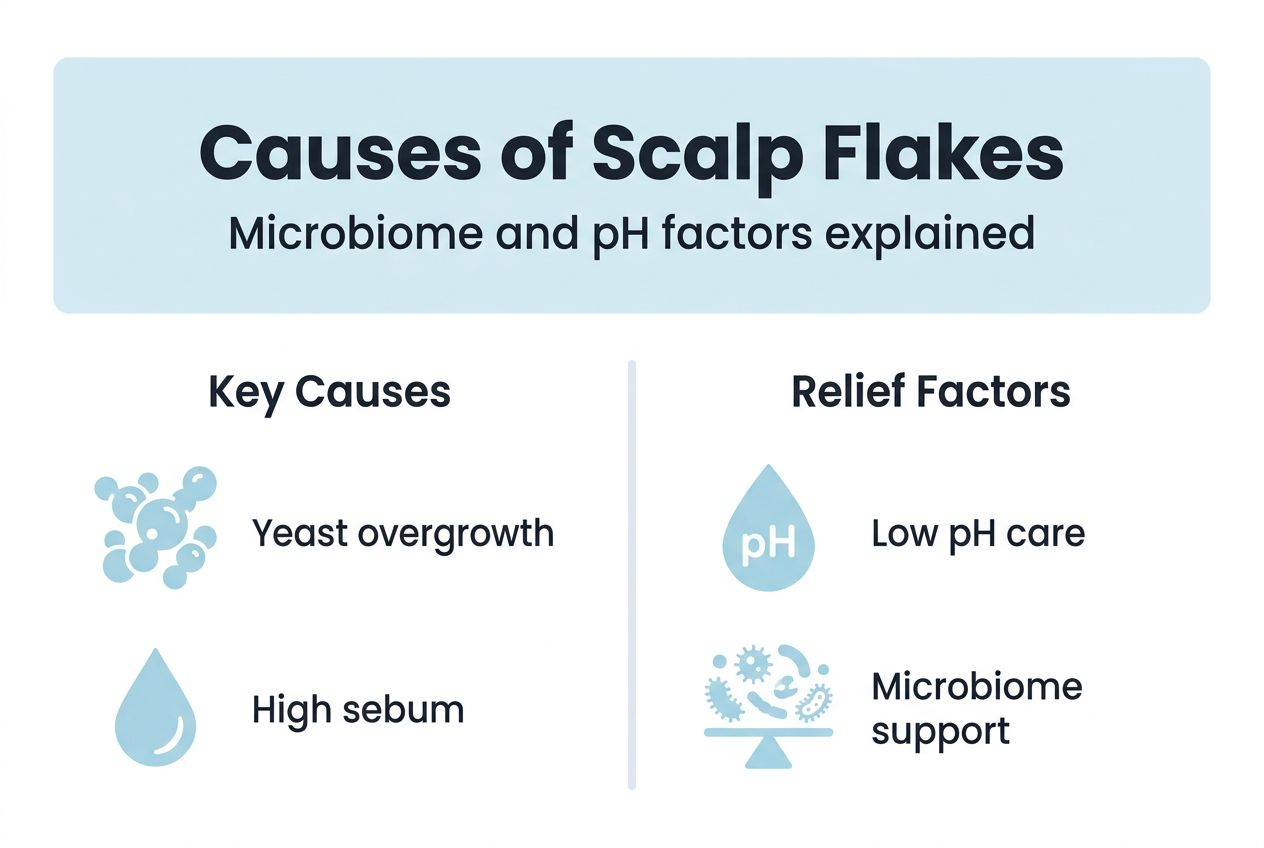
Malassezia is a naturally occurring yeast that lives on almost every human scalp. Under normal conditions it is a quiet, even protective resident, competing with harmful microbes for space and food. It is not an invader. The problem does not begin with Malassezia itself. It begins with the environment it lives in.
This yeast feeds on the lipids in sebum. When the scalp produces too much sebum, or when the composition of that sebum changes due to diet, hormones, pH imbalance or chemical disruption, Malassezia can shift from a quiet passenger to an overactive presence. From there the cascade unfolds:
- Microbiome disruption: an overgrowth crowds out the beneficial microbes that normally keep the scalp in balance, weakening its natural defences
- Immune activation: the body treats the by-products of that overgrowth as a threat and responds with inflammation, which speeds up skin cell production and shedding
- Barrier dysfunction: chronic inflammation weakens the outer layer of the scalp, letting moisture escape and irritants in, which keeps the flaking cycle going
- Sebum composition: differences in individual sebum help explain why some people develop severe dandruff and others never do
Your scalp's microbiome balance decides how Malassezia behaves and whether it stays harmless or becomes a trigger. Sebum output matters too, because the yeast feeds on it. That is why dandruff often worsens during hormonal changes that increase oil production. Sebum alone does not cause dandruff, though, or every oily scalp would flake. It does not.
Pro Tip: Avoid overwashing and harsh products that strip beneficial microbes. Stripping the scalp is what creates the opening for Malassezia to dominate in the first place.
The importance of scalp pH in flaking
Your scalp is supposed to be slightly acidic. Its healthy range is between 4.5 and 5.5 on the pH scale, and that acidity does real work. It keeps yeasts like Malassezia and unwanted bacteria in check, supports the natural skin barrier and encourages the beneficial microbes you want to keep. Dandruff-affected scalps typically show a raised pH, often drifting toward neutral or alkaline.
When pH rises, several things go wrong at once. The acid mantle weakens, so water escapes and irritants get in. Enzymes involved in healthy skin cell maturation stop working properly, because many of them need acidic conditions. And the microbial community itself shifts, as the beneficial bacteria adapted to acidity decline and opportunists tolerant of higher pH move in.
| Scalp condition | Typical pH range | Microbiome status | Barrier function |
|---|---|---|---|
| Healthy scalp | 4.5-5.5 | Diverse, balanced | Intact, protective |
| Dandruff prone | 6.0-7.0 | Malassezia dominant | Compromised, permeable |
| Post harsh shampoo | 7.0-8.0 | Severely disrupted | Temporarily damaged |
Most conventional shampoos sit between pH 6 and 8, well above your scalp's optimal range. Each wash lifts the pH, and washing often enough never lets it recover. This is why the product on the shelf matters less than the number on the label. Restoring an acidic pH stabilises the microbiome by creating conditions where the good organisms outcompete the bad, and it does so without the harsh antimicrobials that damage the whole ecosystem.
Pro Tip: Do not trust the marketing. Trust the pH. Words like "gentle", "natural" and "pH balanced" are unregulated. If a brand does not disclose an actual pH close to 4.5 to 5.5, assume the product is not suitable for a sensitive or healing scalp.
Chemical suppression and dependency cycles
Think of your scalp like a garden. In a healthy garden the soil has the right pH, the right moisture and the right balance of organisms, and it supports life without constant intervention. But if you spray harsh chemicals on it every single day to suppress weeds, you create constant imbalance and dependency. That is exactly what long-term anti-dandruff shampoo use does to your scalp.
Daily use of harsh anti-dandruff shampoo disrupts the microbiome, and the dependency loop that follows is predictable:
- Initial effectiveness: the actives knock back Malassezia and the flaking eases within days
- Microbiome depletion: daily use strips away protective bacteria faster than they can recover
- Resilience loss: the scalp loses its own ability to resist overgrowth as diversity falls
- Rebound flaking: stop for a few days and the yeast surges back into the vacuum, often worse than before
So you use the product more often, and now you cannot stop without a flare. That is not your scalp being broken. It has simply been conditioned to survive in an artificial environment. The treatment quietly became the dependency. While that is a very good business model for the brands that rely on it, it is not the Victory Serums approach.
Here is what the loop looks like, so you can recognise it:
- You notice flakes or itching
- You buy a medicated or off-the-shelf anti-dandruff shampoo
- It helps, briefly
- The problem returns or worsens within days or weeks
- You start using it more often, possibly daily
- Now you cannot stop, or it flares again
- Years pass
Microbiome-friendly treatment principles
Effective scalp care restores diversity and barrier function rather than suppressing one organism forever. This is what breaks the loop, because it lets the scalp regulate itself again. A few principles guide microbiome-balanced care:
- Respect the pH: use products formulated close to the scalp's acidic range so beneficial microbes can thrive
- Less product is better: apply targeted treatment during a flare, not daily, and give the microbiome room to recover between uses
- Reduce over time: as symptoms settle, use less, training the scalp to hold its own balance with less help
- Support the whole ecosystem: a robust community controls opportunists on its own, so the goal is diversity, not eradication
| Approach | Harsh medicated shampoos | Microbiome-friendly maintenance |
|---|---|---|
| pH level | 6.0-8.0 (alkaline) | Low, close to the natural range |
| Usage frequency | Daily or every wash | Weekly or as needed |
| Microbial impact | Broad-spectrum killing | Selective ecosystem support |
| Barrier effect | Strips protective lipids | Preserves or restores the barrier |
| Long-term outcome | Chemical dependency | Scalp self-regulation |
This difference in philosophy is why scalp care is not hair care. Your hair tolerates alkaline products and frequent washing. The skin underneath needs the same gentle approach you would use on your face. A targeted serum has an advantage here. Applied directly to the scalp in a small volume, it delivers what is needed exactly where it is needed, without immersing your whole head in harsh surfactants.
The role of nutrition and gut health
Your diet influences scalp inflammation and microbial balance through several pathways. An anti-inflammatory diet lowers the systemic inflammation that makes the scalp overreact to normal residents like Malassezia. The gut and the skin are connected, and the diversity of your gut microbiome shapes how your immune system responds across the whole body, scalp included.
Nutrients that support scalp health include:
- Omega-3 fatty acids: reduce inflammation and support the skin barrier's lipid composition
- Zinc: essential for skin cell development and immune function; deficiency is linked to more flaking
- B vitamins: biotin and B6 in particular support healthy cell turnover and sebum regulation
- Probiotics and fermented foods: improve gut diversity and lower the inflammation that reaches the scalp
- Vitamin D: helps regulate immune activity and barrier formation
No single change fixes dandruff, because it arises from several factors at once. Gentle topical care combined with better nutrition, lower stress and decent sleep produces results that no product achieves on its own.
Common misconceptions about scalp flakes
Dandruff is caused by poor hygiene. It is not. Dandruff comes from microbiome imbalance and inflammation, not inadequate washing. Washing more, with harsh products, usually makes it worse.
Dry scalp and dandruff are the same thing. They are different problems needing different approaches. Dry scalp is about insufficient moisture and responds to gentle hydration. Dandruff involves inflammatory Malassezia overgrowth and can worsen if you simply moisturise it.
Washing more often clears dandruff. More washing usually raises pH and disrupts the microbiome, stripping both good microbes and protective lipids and setting up the next flare.
Dandruff is purely a fungal infection. Malassezia plays a central role, but dandruff is a complex inflammatory condition. Treating it as an infection alone addresses one part and ignores the environment that allowed the overgrowth.
Long-term scalp health strategies
Lasting control comes from a structured approach that progressively restores the scalp's own regulation, not indefinite symptom suppression. The 1-Week Scalp Health Guide is built around three phases:
- Reset: address the active flare with targeted treatment, reducing symptoms while minimising microbiome disruption
- Rebalance: gradually reduce treatment frequency as symptoms improve, supporting recovery with low-pH maintenance
- Restore: step back to minimal intervention, using treatment only during the occasional flare while the scalp holds its own balance
Alongside this, it helps to track your own patterns. Dandruff severity moves with stress, diet, season and hormones, and knowing your triggers lets you act before a full flare develops. Expect gradual improvement over weeks to months rather than an overnight fix. After years of chemical suppression the scalp needs time to rebuild its resilience, and patience through that transition is what stops people abandoning an approach that was actually working.
Explore microbiome-friendly scalp care solutions
Victory Serums is an Australian, pharmacist-developed range formulated with pH balance and microbiome preservation as the core priorities. The approach lines up with the science set out above: support the scalp, use less, and let it return to its natural state.
The microbiome-friendly scalp serum delivers targeted relief during a flare without the broad-spectrum damage typical of medicated shampoos, and it is designed to be used sparingly. The complete dandruff control range covers each stage of the Reset, Rebalance, Restore process. There is also a free 1-Week Scalp Health Guide that walks you through the phases with tracking tools, so you can apply these principles methodically rather than by guesswork.
Frequently asked questions
What are the main causes of scalp flakes?
Scalp flakes mainly result from Malassezia overgrowth, a disrupted scalp barrier and microbiome imbalance, which together drive inflammation and accelerated skin cell turnover. An elevated scalp pH above the natural acidic range contributes as well, by favouring the wrong organisms and weakening protective barrier lipids.
Can harsh shampoos make dandruff worse?
Yes. Harsh shampoos disrupt the microbiome by killing beneficial bacteria alongside the problem organisms, while raising pH above the healthy range. This damages the barrier and produces rebound flaking when you stop, which is how the dependency loop begins.
How does scalp pH influence dandruff severity?
An acidic pH between 4.5 and 5.5 supports microbial diversity and an intact barrier that naturally keeps Malassezia in check. As pH rises toward neutral or alkaline, the barrier weakens, yeast overgrows and diversity falls, all of which increase flaking.
What lifestyle changes can help reduce scalp flakes?
An anti-inflammatory diet with adequate omega-3s, zinc and B vitamins supports scalp immune responses and barrier function. Improving gut diversity through probiotics and fermented foods helps too. Reducing harsh product use, managing stress and getting quality sleep all support a balanced scalp.
Victory Serums products are designed to support scalp comfort and scalp health practices. They are not intended to diagnose, treat, cure or prevent medical conditions. If symptoms are severe, persistent, cracked, bleeding or worsening, seek guidance from a qualified healthcare professional.
Recommended
- What causes scalp flakes? Malassezia affects 80% of cases – Victory Serums
- Why Does My Scalp Itch? Microbiome Care Guide – Victory Serums
- Why Scalp Care Differs from Hair Care – Victory Serums
- Australian-made scalp care: microbiome balance – Victory Serums

Get the free 1-Week Guide to Scalp Health and uncover the real cause of your flakes.
Download the free guide
Matt Heron is the founder of Victory Serums, an Australian microbiome focused scalp care brand specialising in severe dandruff, yeast imbalance and chronic scalp instability. With more than four decades of personal experience managing persistent dandruff and extensive study of scalp biology, skin pH and barrier function, he developed targeted scalp serums that work within minutes or as leave in treatments. His Reset, Rebalance and Restore approach challenges daily anti-dandruff shampoo dependence and is helping redefine the way chronic dandruff is treated.