

Updated July 2026
In Brief:
- Residue-free scalp care minimises product buildup, which supports the microbiome and natural regulation.
- It means gentle, rinse-off products without silicones, heavy waxes or film-forming agents.
- Pairing a residue-free routine with targeted actives makes those actives work better.
Frequent washing and strong anti-dandruff shampoos feel like the logical answer to chronic flaking. But for many people that approach keeps the cycle going rather than breaking it. Scalp microbial imbalance contributes directly to dandruff and irritation, which means the products and habits you use every day either support or disrupt that balance. Residue-free scalp care takes a different angle: it reduces the chemical load, supports the microbiome, and creates the conditions your scalp needs to regulate itself.
What does residue-free scalp care really mean?
Residue-free scalp care is about minimising what gets left behind after washing or styling. Most people focus on what a product does while it is on their head. Fewer think about what stays there once rinsing is done.
Residue comes from several sources. Silicone-heavy conditioners coat the scalp without fully rinsing out. Styling products like waxes, dry shampoo and volumisers accumulate over days. Even some shampoos leave surfactant residue that disrupts natural pH. Hard water adds mineral deposits on top of all that.
A common misconception is that residue-free means no treatment at all. That is not right. It simply prioritises non-occlusive products, meaning products that do not block the scalp or trap irritants beneath a chemical film. Understanding scalp care versus hair care helps clarify this. Hair care focuses on the shaft. Scalp care focuses on the skin beneath, which has its own microbiome, oil production and sensitivity.
What residue-free scalp care includes:
- Gentle, rinse-off cleansers with no silicones or heavy waxes
- Water-soluble styling products that wash out fully in one rinse
- Scalp serums applied directly and absorbed without film-forming agents
- Avoiding layering multiple leave-in products on the scalp
- Cleansing frequency based on your scalp's actual needs, not habit
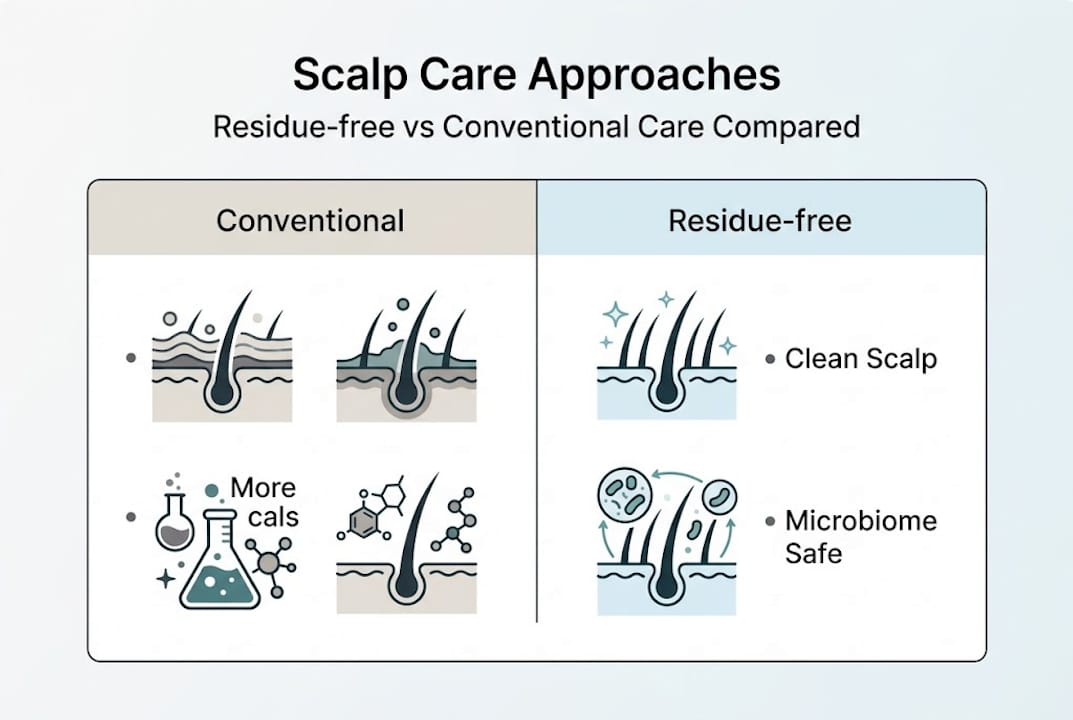
| Factor | Conventional care | Residue-free care |
|---|---|---|
| Product buildup | Common, accumulates over days | Minimal, rinses out fully |
| Microbiome impact | Frequently disruptive | Designed to preserve balance |
| pH awareness | Rarely considered | Central to product selection |
| Wash frequency | Often daily | Matched to scalp condition |
| Scalp dependency | Can increase over time | Aims to reduce dependency |
The goal is not to use nothing. It is to use the right things in the right amounts, so your scalp can do more of the work itself.
Why your scalp microbiome needs a residue-free approach
Your scalp hosts a complex community of bacteria, fungi and other microorganisms. Most are beneficial. They regulate oil, compete with harmful species and help maintain natural acidity. When that community is balanced, the scalp stays calm.
When the balance shifts, problems follow. Microbial imbalance is directly implicated in dandruff, and product residue is one of the less-discussed contributors. Residue traps heat and moisture, creates a substrate for fungal overgrowth, and alters pH. All of that favours the problematic species, particularly Malassezia.
| Residue type | Microbiome effect | Risk level |
|---|---|---|
| Silicone coating | Occludes the scalp, raises local pH | Moderate to high |
| Dry shampoo buildup | Absorbs sebum, alters the fungal food source | Moderate |
| Heavy conditioner | Traps moisture, encourages Malassezia growth | High |
| Hard water minerals | Disrupts barrier function | Moderate |
| Surfactant residue | Strips beneficial bacteria along with harmful ones | High |
For people dealing with chronic irritation, relief often starts with simply reducing the residue load before adding anything new. That is especially relevant when managing an oily scalp, where excess sebum already provides a rich environment for the yeast.
Pro Tip: If your scalp flares a day or two after washing, residue from styling products or conditioner may be feeding the problem. Try a one-week pause on all leave-in products and note the difference.
Combining residue-free routines with targeted care
Residue-free routines lay the groundwork, but chronic dandruff often involves an established overgrowth that a clean routine alone cannot resolve quickly.
This is where evidence-based actives become relevant. Dandruff often benefits from actives such as ketoconazole and selenium sulphide used alongside residue-free care. Those ingredients target the fungal population directly, while the residue-free routine removes the conditions that allowed the overgrowth.
The sequence matters. Applying an active to a scalp still coated in residue is less effective, because the residue acts as a barrier and reduces contact with the skin. Cleansing first and applying actives to a clear scalp improves both absorption and outcome.
- Cleanse with a residue-free, low-pH shampoo to clear buildup and prepare the scalp
- Rinse thoroughly, allowing full removal of surfactants before proceeding
- Apply your targeted active, whether a serum, treatment shampoo or medicated rinse
- Leave it in contact for the directed time, then rinse if required
- Follow with a lightweight, non-occlusive product only if needed
- Reduce active frequency as flaking subsides, and return to residue-free maintenance
Pro Tip: Most people over-apply anti-dandruff treatments, thinking more product means faster results. A small amount on a clean, residue-free scalp consistently outperforms heavy application on a coated one.
| Approach | Best for | Typical timeline |
|---|---|---|
| Residue-free only | Mild flaking, maintenance phase | 4 to 8 weeks |
| Residue-free plus actives | Chronic or moderate to severe dandruff | 2 to 6 weeks for initial relief |
| Actives without residue-free | Addressing fungal load only | Slower, less consistent results |
How to build a residue-free routine
Applying these principles does not require a complete overhaul of your bathroom cabinet. It requires a clear process and better ingredient awareness.
Start with your shampoo. Look for formulas without silicones (ingredients ending in -cone or -siloxane), without heavy conditioning polymers, and without film-forming agents. A low-pH formula, ideally below pH 5, better aligns with the scalp's natural environment.
Less product, applied correctly and infrequently, consistently outperforms more product applied daily. That is the foundation of microbiome-friendly scalp care.
- Wash frequency: match it to your scalp type. Oily scalps may need washing every two to three days; dry or sensitive scalps can often go longer.
- Cleanser choice: silicone-free, low-sulphate, pH-aware formulas.
- Conditioner use: apply from mid-length to ends only, keeping it off the scalp entirely.
- Styling products: water-soluble only, and never applied directly to the scalp.
- Dry shampoo: occasional use only. Never layer it over existing buildup.
- Scalp serums: use targeted, lightweight formulas applied to a dry scalp for direct contact.
For ongoing dandruff prevention, tracking which products correlate with flare-ups is one of the most practical tools available. Keep it simple: note what you used and how your scalp felt 24 to 48 hours later.
Pro Tip: Rinse your scalp for 30 seconds longer than you think is necessary. Most residue problems come from insufficient rinsing, not the product itself.
A realistic approach
The term "residue-free" gets used loosely in product marketing. Some products labelled that way still contain film-forming polymers that accumulate over time. The label alone is not enough. Reading the ingredient list matters more than the front-of-pack claim.
A trial period is normal. Your scalp has adapted to its current product environment, and changing routines can cause a temporary adjustment phase. Some people notice more oiliness or minor irritation in the first week or two. That usually settles as the scalp recalibrates.
Consistency matters more than perfection. A routine that is 80% dialled in and maintained for six weeks will outperform a perfect routine followed for ten days. Chronic or severe irritation that does not improve within four to six weeks warrants a dermatologist review.
Try residue-free, microbiome-friendly scalp solutions
If the buildup cycle has been driving your flaking and irritation, a residue-aware approach can break it. Victory Serums provides pharmacist-developed, microbiome-compatible options designed for exactly this situation.

The microbiome-friendly scalp serum delivers active ingredients directly to the scalp with minimal chemical interference and no residue trail. Explore the full dandruff control range to find options matched to your scalp condition.
Frequently asked questions
Are residue-free routines safe for colour-treated hair?
Yes, most are. Check for colour-safe labelling and avoid harsh sulphates that may strip colour faster.
Can residue-free care cure dandruff permanently?
It significantly reduces flare-ups and supports long-term balance, but chronic dandruff often needs evidence-based actives for full control.
How long before a residue-free routine improves irritation?
Visible improvement often begins within one to two weeks, with steadier results developing over four to eight weeks of maintained care.
Will a residue-free routine reduce oiliness?
Yes. By clearing buildup that traps irritants, it allows the scalp to regulate oil production more naturally over time.
Should I avoid all styling products?
Not entirely. Choose lightweight, water-soluble products, apply them away from the scalp, and rinse thoroughly at each wash.
Victory Serums products are designed to support scalp comfort and scalp health practices. They are not intended to diagnose, treat, cure or prevent medical conditions. If symptoms are severe, persistent, cracked, bleeding or worsening, seek guidance from a qualified healthcare professional.
Recommended
- Oily scalp management guide for microbiome balance in 2026 – Victory Serums
- Why Scalp Care Differs from Hair Care – Victory Serums
- Understanding anti-dandruff agents: sustainable relief – Victory Serums
- Australian scalp care: microbiome balance for 2026 – Victory Serums

Get the free 1-Week Guide to Scalp Health and uncover the real cause of your flakes.
Download the free guide
Matt Heron is the founder of Victory Serums, an Australian microbiome focused scalp care brand specialising in severe dandruff, yeast imbalance and chronic scalp instability. With more than four decades of personal experience managing persistent dandruff and extensive study of scalp biology, skin pH and barrier function, he developed targeted scalp serums that work within minutes or as leave in treatments. His Reset, Rebalance and Restore approach challenges daily anti-dandruff shampoo dependence and is helping redefine the way chronic dandruff is treated.