

Updated July 2026
In Brief:
- Before and after photos can motivate, but on their own they are not reliable evidence of scalp health.
- Objective measures and symptom tracking give a far more accurate picture of progress.
- Real microbiome recovery is quiet and gradual, not dramatic. Track how the scalp feels, not just how it looks.
Before and after photos are everywhere in scalp care marketing. They feel convincing. But for anyone managing chronic dandruff with minimal chemicals, photos alone tell an incomplete story. The real question is not just whether something looks better, but whether the scalp is genuinely rebalancing at a functional level. This guide breaks down what before and after results actually reveal, where they fall short, and how to track progress in a way that supports long-term scalp health.
Why before and after results matter
Before and after results refer to any documented change in scalp condition over a period of treatment. That includes photographs, symptom ratings, itch scores and flake coverage. Photos are the most visible form of evidence, but they are also the easiest to manipulate through lighting, angle and styling. Clinical outcomes, by contrast, use standardised scales to record objective change.
For anyone building a gentle, microbiome-compatible routine, documentation serves a practical purpose. It helps you understand whether a product is working, whether to continue, and whether to reduce usage over time. Motivation matters too. Seeing visible improvement, even subtle improvement, encourages consistency.
However, photos without supporting data can mislead. A scalp that looks clearer after one wash may have simply had excess sebum removed. That is not the same as a microbiome returning to balance.
Clinical trials for dandruff use objective scales such as adherent dandruff scores and visual analogue scales for scaling and redness, rather than relying solely on photographs.
The trade-offs of before and after documentation:
- Pro: motivates ongoing commitment to a routine
- Pro: provides a clear visual reference across weeks or months
- Pro: helps identify triggers when combined with a symptom diary
- Con: lighting, angle and hair position significantly affect perceived results
- Con: photos cannot show microbiome shifts or pH changes
- Con: dramatic visual results do not always mean long-term improvement
- Con: subtle but meaningful progress is often invisible in photos
Clinical evidence versus photo proof
Clinical trials use specific endpoints to measure improvement: visual analogue scales for itch and scaling, adherent dandruff scores, sebum production rates and, increasingly, microbiome analysis. These tools capture changes a camera simply cannot.
The problem with before and after photos is not that they are useless. It is that they are frequently used as proof of efficacy without any supporting data. A single image taken under flattering light proves very little on its own.
One area where visual and quantitative evidence genuinely align is with gentle formulations that preserve beneficial bacteria, where measurable reductions in flaking show up alongside visible improvement. That kind of alignment is meaningful. Understanding what causes scalp flakes helps frame why such outcomes matter beyond aesthetics.
| Measure | Photo documentation | Clinical metrics |
|---|---|---|
| Flake visibility | Yes | Yes, via dandruff score |
| Itch level | No | Yes, via visual analogue scale |
| Microbiome balance | No | Yes, via microbial analysis |
| Sebum output | No | Yes, via sebumeter |
| Redness | Partially | Yes, via erythema index |
| Reproducibility | Low | High |
How clinicians measure scalp improvement:
- Establish a baseline using standardised scales before treatment begins
- Photograph the scalp under consistent, controlled lighting at each review
- Record patient-reported symptoms including itch, tightness and sensitivity
- Assess dandruff coverage using adherent flake scoring
- Review microbiome or sebum data where available
- Compare baseline to follow-up scores to calculate measurable change
You can adapt these steps at home without clinical equipment, using consistent photography and symptom recording. The Australian guidelines acknowledge patient-reported outcomes as valid indicators of treatment response.
Tracking progress for a gentle routine
Microbiome-friendly routines are defined by restraint: lower product volume, reduced frequency, pH-aware formulations. That makes tracking more important, not less, because progress is gradual and subtle rather than dramatic. Without a record, it is easy to underestimate how far the scalp has come.
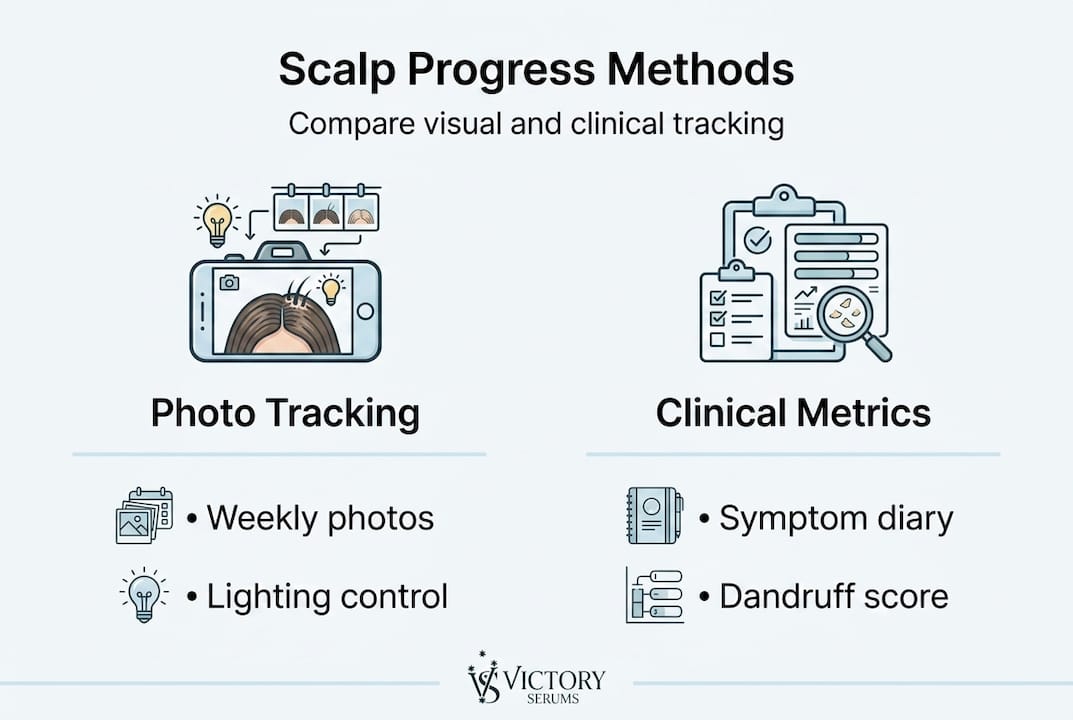
Standardised self-photos enable tracking without requiring clinician visits, provided the photographs are taken under consistent conditions.
Pro Tip: Use the same room, same light source and same hair parting every time you photograph your scalp. Even small variations in lighting can make a healthy scalp look worse, and vice versa. Weekly photos on the same day after the same routine give the most reliable comparison.
Best practice for home tracking:
- Keep a symptom diary noting itch, tightness and flaking on a scale of 1 to 10
- Photograph bare scalp sections under natural light at the same time each week
- Use the same hair parting and keep styling products out of photos
- Note product usage, including frequency and volume applied
- Record any dietary changes or stress events that may influence the scalp
- Review your diary monthly rather than daily, to spot genuine trends
| Method | Home use | Clinical standard |
|---|---|---|
| Symptom diary | Practical and accessible | Patient-reported outcome measures |
| Standardised photography | Achievable with a phone | Controlled clinical photography |
| Itch rating (1 to 10) | Simple self-assessment | Visual analogue scale |
| Microbiome analysis | Not available at home | Laboratory sequencing |
| Sebum measurement | Not available at home | Sebumeter device |
Sharing your diary and photos with a GP or dermatologist gives them useful context and makes consultations more productive.
Australian guidelines and real-world application
Australian clinical guidance for seborrhoeic dermatitis focuses on anti-yeast treatments such as ketoconazole and selenium sulphide, plus short-term topical anti-inflammatories for inflamed cases on medical advice. The guidelines do not require before and after photo documentation. The emphasis is on clinical response, which includes patient-reported symptom improvement.
That is worth knowing. You do not need to produce photographic proof for your practitioner. What matters is whether your symptoms are improving, staying stable or worsening, and that is information you can gather through consistent self-tracking.
- Start with a clear baseline: rate your itch, scaling and redness from 1 to 10 before beginning any new routine
- Follow a structured approach: apply products at the recommended frequency, not daily unless specified
- Track weekly: record symptoms and photograph your scalp on the same day each week
- Review at four weeks: compare baseline ratings with current scores to identify a pattern
- Discuss with your practitioner: bring your diary and photos to consultations
- Adjust based on evidence: if both objective and subjective measures improve, consider reducing product frequency rather than increasing it
What most people get wrong
The biggest mistake is chasing dramatic results. Social media promotes images of rapid, visible transformation. That is rarely what genuine microbiome recovery looks like. Real progress is usually quiet: fewer flares, lighter flaking, reduced itch, longer intervals between product use.
Consistent small improvements sustained over months are far more meaningful than a striking two-week photo set. They signal that the scalp is genuinely rebalancing rather than being temporarily suppressed.
Pro Tip: Document how your scalp feels alongside how it looks. Less tightness, reduced sensitivity and fewer itchy episodes are valid indicators of progress, and they often appear before visible changes do.
Your most reliable evidence is not a before photo and an after photo. It is how your scalp behaves consistently over several months with reduced product reliance.
Find microbiome-friendly solutions for your scalp
Tracking progress works best when paired with products designed for the same careful approach. Victory Serums offers pharmacist-developed scalp solutions built around microbiome compatibility and pH awareness.

The scalp serum is formulated for minimal, structured use rather than daily dependency. The goal is to reduce the need for intervention over time, not increase it. Explore the full range of dandruff control products and find the right starting point.
Frequently asked questions
Are before and after photos reliable for choosing products?
They can be motivating but should be paired with objective data for genuine confidence. Photos complement rather than replace validated symptom scales.
What is the difference between clinical trials and online before-after photos?
Clinical trials use validated scoring tools to measure real improvement, not appearance alone. Objective scales provide reproducible evidence that photography cannot.
How can I track my routine's progress at home?
Use standardised photos under consistent lighting, a weekly symptom diary, and regular self-assessments of itch and flaking. That is enough to track progress without a clinician visit.
Do Australian guidelines require photo proof for treatment?
No. They focus on clinical and patient-reported response, with no requirement for photographic documentation.
Victory Serums products are designed to support scalp comfort and scalp health practices. They are not intended to diagnose, treat, cure or prevent medical conditions. If symptoms are severe, persistent, cracked, bleeding or worsening, seek guidance from a qualified healthcare professional.
Recommended
- Oily scalp management guide for microbiome balance in 2026 – Victory Serums
- Why Scalp Care Differs from Hair Care – Victory Serums
- Understanding anti-dandruff agents: sustainable relief – Victory Serums
- Australian scalp care: microbiome balance for 2026 – Victory Serums

Get the free 1-Week Guide to Scalp Health and uncover the real cause of your flakes.
Download the free guide
Matt Heron is the founder of Victory Serums, an Australian microbiome focused scalp care brand specialising in severe dandruff, yeast imbalance and chronic scalp instability. With more than four decades of personal experience managing persistent dandruff and extensive study of scalp biology, skin pH and barrier function, he developed targeted scalp serums that work within minutes or as leave in treatments. His Reset, Rebalance and Restore approach challenges daily anti-dandruff shampoo dependence and is helping redefine the way chronic dandruff is treated.